On this page
The short answer
The PSA Population Report is PSA’s running count of every card it has graded, broken down by set, card and grade. It shows how many PSA 10s of a card exist and what share of graded copies reached a 10, the gem rate. It counts slabs, not cards: resubmissions inflate it, and raw copies never appear.
What is the PSA pop report?
It’s PSA’s tally of every card it has graded and sealed in a slab, one row per card and one column per grade. PSA’s own description is “a tally of every single card we have ever graded and encapsulated,” broken down by set, player and grade.
Collectors call it the pop report, and a card’s count at a grade is its pop. If a card has a PSA 10 pop of 123, PSA has handed out 123 PSA 10 labels for it. That number is the closest thing the hobby has to a scarcity figure for graded cards, which is why sellers quote it in listings and buyers check it before paying a premium.
Two things it is not. It isn’t a count of how many copies exist, only of how many went through PSA. And it doesn’t include cards PSA refused to grade for alteration, trimming or doubts about authenticity, which PSA points out itself.
How do you look up a card in the PSA pop report?
Go to psacard.com/pop, pick TCG Cards, then the year and the set, and find your card’s row. On 21 October 2026 that needed a PSA account: opening a Pokémon set page while signed out on 21 October 2026 sent us to a sign-in page that asks for an email to sign in or create an account.
- Open the TCG Cards category. Pokémon sits under trading card games, not sports. The page addresses follow category, year and set, so a 1999 card lives under 1999.
- Pick the exact set and language. PSA files sets under its own names, and Japanese, 1st Edition, Shadowless and Unlimited printings are separate sets or separate rows. Check the set symbol and card number against your card first.
- Find the card number, not just the name. A popular Pokémon can have a dozen rows in one set: the holo, the reverse holo, promos and stamped versions. Match the number and any variety words, such as “1st Edition” or “Holo.”
- Read across the grade columns. Each column is a grade. The figure under 10 is the PSA 10 pop.
Can you check a pop without an account?
Yes, for one slab at a time. PSA’s cert verification page was still public on 21 October 2026. Type the certification number from the label and it shows the card’s Population, its Population w/Qual and its Population Higher. That’s the quickest way to check a pop a seller quotes, and it confirms the slab is real at the same time. Our PSA cert lookup guide walks through it.
How do you read a PSA population report?
Read three numbers: the count at your grade, the count above it, and the share of all graded copies that made a 10. Together they tell you how scarce a grade is and how hard the card is to grade well.
- PopWhat it means How many copies PSA has graded at exactly this gradeHow to use it The scarcity of that grade at PSA
- Pop higherWhat it means How many copies PSA has graded above this gradeHow to use it 0 means nothing graded better at PSA
- Pop with qualifierWhat it means Copies given this grade with a qualifier such as OC (off center), counted apartHow to use it A PSA 8 OC is not in the plain PSA 8 count
- Gem rateWhat it means PSA 10s divided by all graded copiesHow to use it How hard the card is to get a 10
- Pop 1What it means Only one copy at that gradeHow to use it Ask whether any are graded higher
| Term | What it means | How to use it |
|---|---|---|
| Pop | How many copies PSA has graded at exactly this grade | The scarcity of that grade at PSA |
| Pop higher | How many copies PSA has graded above this grade | 0 means nothing graded better at PSA |
| Pop with qualifier | Copies given this grade with a qualifier such as OC (off center), counted apart | A PSA 8 OC is not in the plain PSA 8 count |
| Gem rate | PSA 10s divided by all graded copies | How hard the card is to get a 10 |
| Pop 1 | Only one copy at that grade | Ask whether any are graded higher |
Qualifiers are worth a second look, because a qualified grade sells below the same number without the code. If you want to know what OC, ST or MK means, our PSA grading scale guide covers each one.
How do you work out the gem rate?
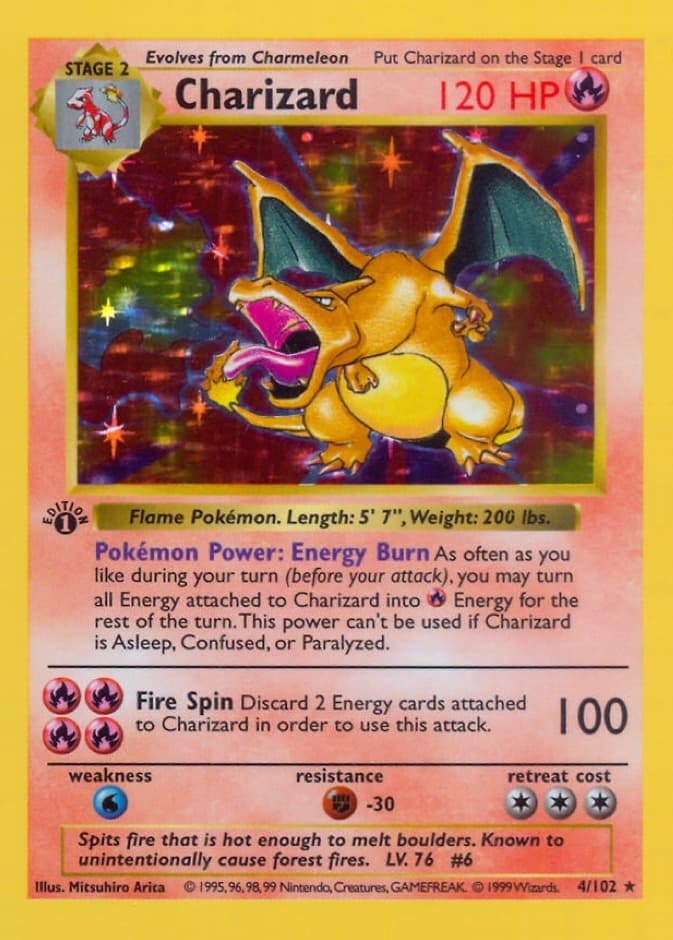
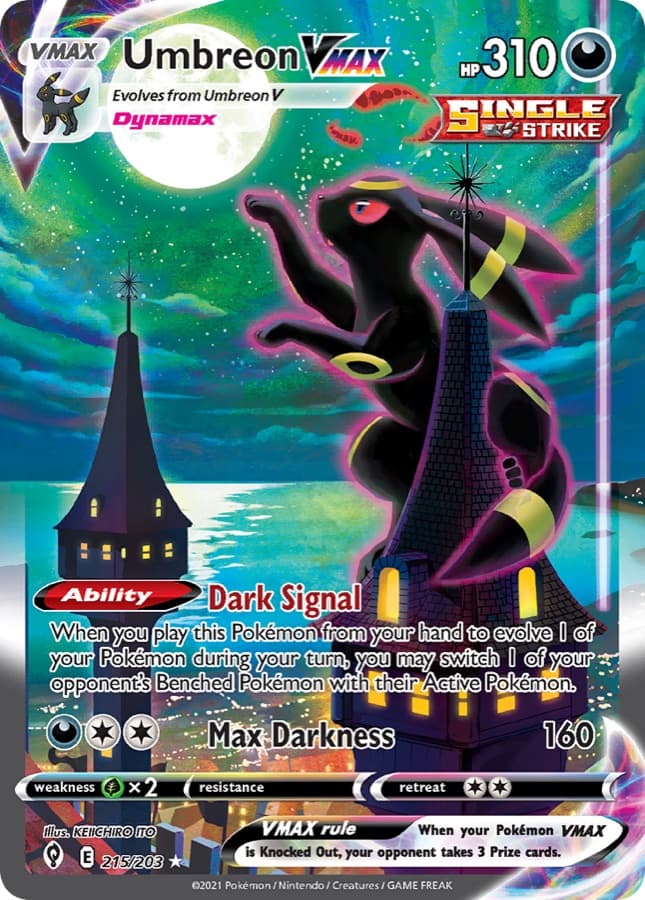
Divide the PSA 10 pop by the total graded. TCG Charts, which shows PSA’s counts next to its prices, gave the 1st Edition Base Set Charizard 123 PSA 10s on 21 October 2026, a PSA 10 rate of 2.1%. The Umbreon VMAX alt art from Evolving Skies had 21,835 PSA 10s, a rate of 69.1%. Cards that spent decades in binders and shoeboxes gem rarely; modern cards pulled straight into sleeves gem often.
What does pop 1 mean?
It means PSA has graded one copy at that grade. On its own that says little. A pop 1 PSA 10 with nothing higher is the single best copy PSA has seen. A pop 1 PSA 6 with 300 copies above it is just an unusual grade. And a pop 1 of a card worth a few dollars usually means nobody bothered to send another in.
Does population affect a card’s price?
Yes, at the top grade. When a card’s PSA 10 pop is small and steady, every buyer who wants the best copy chases the same few slabs, so the 10 sells for many times a 9. When the PSA 10 pop is large and still growing, the 10 carries a much smaller premium.
- Pikachu Illustrator, 1998 promoPop 110s 1 · 9s 1511.7×
- Charizard 4/102, 1st Edition10s 123 · 9s 7347.5×
- Umbreon VMAX 215/203, Evolving Skies10s 21,835 · 9s 6,5811.7×
| Card | PSA 10s | PSA 9s | 10 vs 9 price |
|---|---|---|---|
| Pikachu Illustrator, 1998 promoPop 1 | 1 | 15 | 11.7× |
| Charizard 4/102, 1st Edition | 123 | 734 | 7.5× |
| Umbreon VMAX 215/203, Evolving Skies | 21,835 | 6,581 | 1.7× |
The Charizard is the clearest case. TCG Charts valued a PSA 10 at $450,000 and a PSA 9 at $60,250, and there are six PSA 9s for every PSA 10. Its PSA 10 count has barely moved since late 2025: Heritage described its December 2025 sale, at $550,000, as one of 125 PSA 10s, and since then copies have sold for $954,800 at Goldin and $1,000,952.84 on eBay. Our Charizard card value guide has the full price ladder.
The Pikachu Illustrator is the pop 1 extreme. Heritage noted that PSA had certified 15 copies in Mint 9 with only one graded higher. That one, a PSA 10, sold at Goldin for $16,492,000 in February 2026, while a PSA 9 brought $1,406,250 at Heritage a month later. The Umbreon shows the opposite: with more PSA 10s than every other grade put together, a 10 sold for about $3,501 against $2,050 for a 9 and $1,350 raw.
Is the PSA pop report accurate?
It’s an accurate count of labels PSA has issued, not of cards. The gap between the two is where most bad pop-based decisions come from.
- Resubmissions inflate it. Owners crack PSA 9s out of their slabs and resubmit them hoping for a 10. The card stays in the PSA 9 count unless someone returns the old label to PSA, and most people don’t, so one card can show up as several.
- Crossovers count twice. A card moved from a CGC or Beckett slab into a PSA slab now sits in both companies’ reports, because no grader knows when a card leaves another company’s slab.
- Cracked cards stay counted. A card broken out of its slab to keep raw, or to sell raw, never leaves the report.
- Raw supply is invisible. Thousands of ungraded copies, or sealed packs still unopened, can sit outside the report. A low pop on a card nobody has bothered to grade yet can jump fast.
- Gem rate is for submitted cards. People send in their best copies, so the rate describes cherry-picked cards. It isn’t the chance that a random copy, or yours, comes back a 10.
Do CGC, Beckett, TAG and SGC have pop reports?
All five main graders publish one, and each counts only its own slabs. To judge how many top-grade copies of a card exist across the hobby, add the PSA 10s, CGC 10s, Beckett 9.5s and 10s, TAG 10s and SGC 10s, then allow for crossovers counted twice.
| Question | PSA | CGC | Beckett (BGS) | TAG | SGC |
|---|---|---|---|---|---|
| Name | Population Report | CGC Cards Population Report | Pop report | Pop report | Pop Report |
| Sign-in to browse | Yes; cert pages show one card’s pop without it | No | Not checked | No | No, but a CAPTCHA before each search |
| How you find a card | Category, year, set, then the card | Search by name, set or language, or browse by game and era | By sport, set name and player name | Search box, or browse by category and year | Load the set, then find the card |
| Worth knowing | Qualified grades counted apart | Pristine 10 and Gem Mint 10 are separate grades | Pokémon is filed by set name, so exact terms matter | Ranks every scored copy of a card by its TAG Score | Warns that 28 years of data may hold duplicates |
The pops aren’t interchangeable. A CGC 10 and a PSA 10 of the same card sell for different prices, and a CGC Pristine 10 is a harder grade than either. Our guides to the best grading company for Pokémon cards, TAG grading, SGC grading and Beckett grading cover how each one’s top grade sells.
How should you use pop when deciding to grade or buy?
Use pop to set the payoff, and your own card’s condition to set the odds. A small PSA 10 pop tells you a 10 would sell well; it tells you nothing about whether your copy will get one.
- Look up the exact card’s pops. Note the PSA 10 and PSA 9 counts and the gem rate. A card that gems at 2% is a long shot for anyone; one at 70% means a 9 is the grade that hurts.
- Compare 10, 9 and raw prices. If the 10 sells for seven times the 9, the grade is everything. If it sells for under twice, a 9 may barely cover the fee, which starts at $59.99 a card at PSA.
- Grade your copy honestly. Centering front and back, then corners, edges and surface under a bright light. The pop can’t do this part.
- Grade only if the likely grade pays. Our guide to whether grading Pokémon cards is worth it works through the sum.
Using pop when you buy a graded card
Before paying a premium for a “low pop” slab, check three things: the pop on the cert page, not just in the listing; how many copies sit above it; and how often the card sells. A pop of 12 means little if 3,000 raw copies sell every month and nobody has graded them yet. Verifying the cert also matters for another reason: PSA warns that forgers sometimes copy real cert numbers onto fake labels, so compare the card in the slab with the cert’s details and read our guide on how to tell if a Pokémon card is fake.
Questions people ask
What does pop mean on a graded card?
Pop is short for population: how many copies of that card a grading company has graded at a given grade. A PSA 10 pop of 50 means PSA has issued 50 PSA 10 labels for that card.
Where can I find my PSA pop report?
On psacard.com/pop, under TCG Cards for Pokémon, then the year and set. In October 2026 it asked for a PSA account. For a single slab, enter the cert number on PSA’s cert verification page, which shows the pop without signing in.
Is a low pop card always valuable?
No. A low pop matters when the card is in demand and often graded, because then a small count means few copies made the grade. A cheap card can be low pop simply because almost nobody paid to grade it.
Does the PSA pop report include cards that were cracked out?
Usually, yes. A card broken out of its slab stays in the count unless the owner returns the label to PSA, so cards that are cracked and resubmitted can be counted more than once.
Is a PSA 7 a good grade?
PSA 7 is Near Mint: light surface wear or slight corner fraying, with front centering of about 70/30 or better. For vintage cards it is a solid grade; for modern Pokémon cards, where 9s and 10s are common, a 7 often sells for little more than the raw card.
Sources
- PSA, Population Report (sign-in page shown when signed out, checked 21 October 2026)
- PSA, Certification Verification: example cert page showing Population, Population w/Qual and Population Higher (checked 21 October 2026)
- PSA, Market Report: Population Perspective, by Joe Orlando (checked 21 October 2026)
- PSA, Grading Standards: grade definitions and qualifiers (checked 21 October 2026)
- PSA, Trading card grading service levels and prices (checked 21 October 2026)
- TCG Charts, Charizard #4 1st Edition, Base Set: PSA pops by grade and current values (checked 21 October 2026)
- TCG Charts, Umbreon VMAX #215, Evolving Skies: PSA pops by grade, current values and raw price (checked 21 October 2026)
- Heritage Auctions / Intelligent Collector, PSA 10 Charizard record $550,000, one of 125 PSA 10s, December 16, 2025 (checked 21 October 2026)
- Sports Illustrated, Another $1 million Charizard leads biggest TCG sales (checked 21 October 2026)
- Heritage Auctions / Intelligent Collector, Pikachu Illustrator PSA 9 realizes $1,406,250; 15 in Mint 9, one higher, March 31, 2026 (checked 21 October 2026)
- ABC7 / AP, Logan Paul’s Pikachu Illustrator sells for record $16.5M (checked 21 October 2026)
- CGC Cards, Population Report (checked 21 October 2026)
- CGC, Population Report live, April 6, 2022: search and browse options (checked 21 October 2026)
- Rare Candy, Collector’s Guide: Grading with Beckett, June 27, 2024 (secondary source for the Beckett pop report) (checked 21 October 2026)
- TAG Grading, Pop report (checked 21 October 2026)
- SGC, Pop Report (checked 21 October 2026)
Buddy is independent and isn’t affiliated with PSA, CGC, Beckett, TAG, SGC or The Pokémon Company. Fees and prices change; we re-check them when we update a guide.