On this page
The short answer
For most cards, sell on eBay (the most buyers, 13.25% fee) or TCGplayer (modern raw singles, about 14% all in). A $100 card nets roughly $84 to $86 after fees and postage. Graded cards over a few hundred dollars suit Goldin or Fanatics Collect. A local shop pays less but pays today.
Every fee below was read on the platform’s own page on 21 October 2026. Two changed recently: TCGplayer’s commission went from 10.25% to 10.75% this year, and Whatnot moved to sliding commission rates on September 21, 2026. Guides from 2025 quote the old numbers.
What is the best place to sell Pokémon cards?
eBay for graded cards, vintage and anything over $200; TCGplayer for modern raw singles. Those two hold most of the US market for single cards. Whatnot and Facebook fill the gaps: fast auctions for lots, and local cash with no shipping.
| Question | eBay | TCGplayer | Whatnot | |
|---|---|---|---|---|
| Selling fee | 13.25% of the total, + $0.40 an order | 10.75% of the item price | 8% of the item price | None for pickup; 10% shipped (min $0.80) |
| Payment fee | Included | 2.5% of the total + $0.30 | 2.9% of the total + $0.30 | Included |
| Fees on a $100 card | $15.43 | $13.89 | $11.59 | $0 pickup, $11.34 shipped |
| Best for | Slabs, vintage, cards over $200 | Modern raw singles | Lots and quick auctions | Local cash sales |
| The catch | Highest fee | New sellers capped at $500 a card | An auction can close low | Where most scams start |
eBay
eBay charges 13.25% on the whole sale, shipping and sales tax included, up to $7,500, then 2.35% on anything above that, plus $0.40 an order ($0.30 on orders of $10 or less). It has the most buyers and is where graded slabs and vintage sell best. Single cards that sell for $200 or more, raw or graded, go through eBay’s Authenticity Guarantee: you ship to an authenticator, who checks the card and sends it on. eBay pays for that check; you pay the postage to the authenticator.
TCGplayer
TCGplayer takes 10.75% of the item price (capped at $75 a card) plus 2.5% of the order total and $0.30. Its buyers search by set and card number, so modern singles sell fast at the TCGplayer market price. New sellers start with limits that lift as orders arrive without problems.
- Level 1Every new sellerItems 100 · Next 2 orders, 80% feedback$500
- Level 2Items 500 · Next 11 orders, 85% feedback$1,000
- Level 3Items 50,000 · Next 51 orders, 90% feedback$20,000
- Level 4Items Unlimited · Next Top levelNo cap listed
| Level | Items listed | Max per card | To move up |
|---|---|---|---|
| Level 1Every new seller | 100 | $500 | 2 orders, 80% feedback |
| Level 2 | 500 | $1,000 | 11 orders, 85% feedback |
| Level 3 | 50,000 | $20,000 | 51 orders, 90% feedback |
| Level 4 | Unlimited | No cap listed | Top level |
Whatnot and Facebook
Whatnot is live-stream auctions. Since September 21 the commission on trading cards starts at 8% and drops to 6.5% for sellers doing $500,000 every four weeks, plus 2.9% and $0.30 for payment processing on the buyer’s full total. It suits lots and quick turnover; a single card can sell under value if few people are watching.
Facebook Marketplace is free for local pickup. Meta’s seller policy sets a 10% fee, minimum $0.80, on shipped sales, and its Seller Protection only covers items up to $500. Collector groups on Facebook trade a lot of cards, but sales there usually run through PayPal, which charges 2.99% to receive a goods and services payment.
How much do you keep after fees?
About $84 on eBay and $86 on TCGplayer for a $100 card, once you pay for the label and the mailer. Here’s the working for a raw card that sells for $100, with $5 shipping charged to the buyer and 8% sales tax.
A shop sale has no fees and no postage, so the cash offer is what you keep. To match eBay on this card, a shop would have to offer about $84. Most shops pay a good deal less than that in cash for a single card, because they have to resell it and cover their own fees. They often pay more in store credit than cash, so ask for both. For bigger cards the eBay fee drops sharply above $7,500, and TCGplayer’s commission stops at $75 a card.
- Cash in person (pickup, card show)Most moneyFees $0$100
- Facebook Marketplace, shippedFees $11.34$88.16
- Whatnot, if it hammers at $100Fees $11.59$87.91
- TCGplayerFees $13.89$85.61
- eBayFees $15.43$84.07
- Local card shopFees $0Its cash offer
| Where you sell | Fees | You keep |
|---|---|---|
| Cash in person (pickup, card show)Most money | $0 | $100 |
| Facebook Marketplace, shipped | $11.34 | $88.16 |
| Whatnot, if it hammers at $100 | $11.59 | $87.91 |
| TCGplayer | $13.89 | $85.61 |
| eBay | $15.43 | $84.07 |
| Local card shop | $0 | Its cash offer |
Where can I sell Pokémon cards for cash fast?
A local card shop or a card show pays the same day. For PSA-graded cards there are two more instant options: PSA’s own buyer offers and GameStop. Auction houses are slower but reach the biggest buyers for expensive slabs.
| Question | Local shop | PSA Partner Offers | Goldin | Fanatics Collect | Heritage |
|---|---|---|---|---|---|
| Takes | Any card | PSA-graded cards at grade reveal or in PSA Vault | Graded or authenticated, $100+ | Graded, or raw through its authentication partners | Quality consignments |
| Seller fee | None; the margin is in the offer | None | None above $50 hammer; $5 below or unsold | None on graded auctions; 6% or 12% on Buy Now | Not published; quoted per consignment |
| Buyer’s premium | – | – | 22%, minimum $19 | 20% | Set per auction |
| Speed | Cash today | Paid when you accept | Weekly auctions | Weekly and Premier auctions | Slowest |
- Local card shops pay a share of market price, usually more in store credit than cash. Bring sold prices on your phone and get two quotes.
- Card shows put dozens of dealers in one room, so you can shop one card around. Bigger dealers buy graded cards in volume.
- PSA Partner Offers come from dealers in PSA’s network when grades are revealed or while the card sits in your PSA Vault. PSA says there are no fees, but not every card gets an offer.
- GameStop buys PSA-graded cards in grades 8, 9 and 10 in store, up to $1,500 a card in cash or credit. The offer comes from a pricing model and isn’t negotiable.
- Goldin runs Weekly Auctions for graded or authenticated items worth $100 or more, with no listing fee once an item hammers above $50. Its Elite auctions target items worth $7,500 and up.
- Fanatics Collect (formerly PWCC) charges no seller fee on graded cards in its auctions. Premier Auction sellers receive 110% of the hammer price on sales up to $250,000.
- Heritage doesn’t publish a seller’s commission for cards; it quotes terms per consignment.
Buylist sites for bulk
Commons, uncommons and low holos aren’t worth listing one by one. Mail-in buylists buy them by the thousand. Meta TCG’s published rates, for example, were $20 per 1,000 Near Mint English commons and uncommons, $35 per 1,000 reverse holos and $0.50 each for ex, V and GX cards, paid by PayPal within 3 to 5 business days of checking.
How do you price a Pokémon card before selling?
Price from what the exact card sold for recently, never from asking prices. Listings that haven’t sold tell you what sellers hope for, not what buyers pay.
- Identify the exact printing. Set, card number, edition, language and holo pattern all change the price. A reverse holo isn’t the holo.
- Look up sold prices. On eBay, filter by Sold Items. On TCGplayer, check the card’s recent sales and market price.
- Match the condition. Compare a raw card with raw sales in the same condition, and a slab with sales at the same grade from the same grader.
- Price for the speed you want. At the recent average it sells in days. Above it, you wait or take offers.
Condition is where most sellers overprice. A card that looks clean in a binder can have whitening on the back edges or off-center borders, and buyers will check your photos for both. Our guide to what your Pokémon card is worth covers the lookup in more detail.
How do you photograph and describe a card to sell?
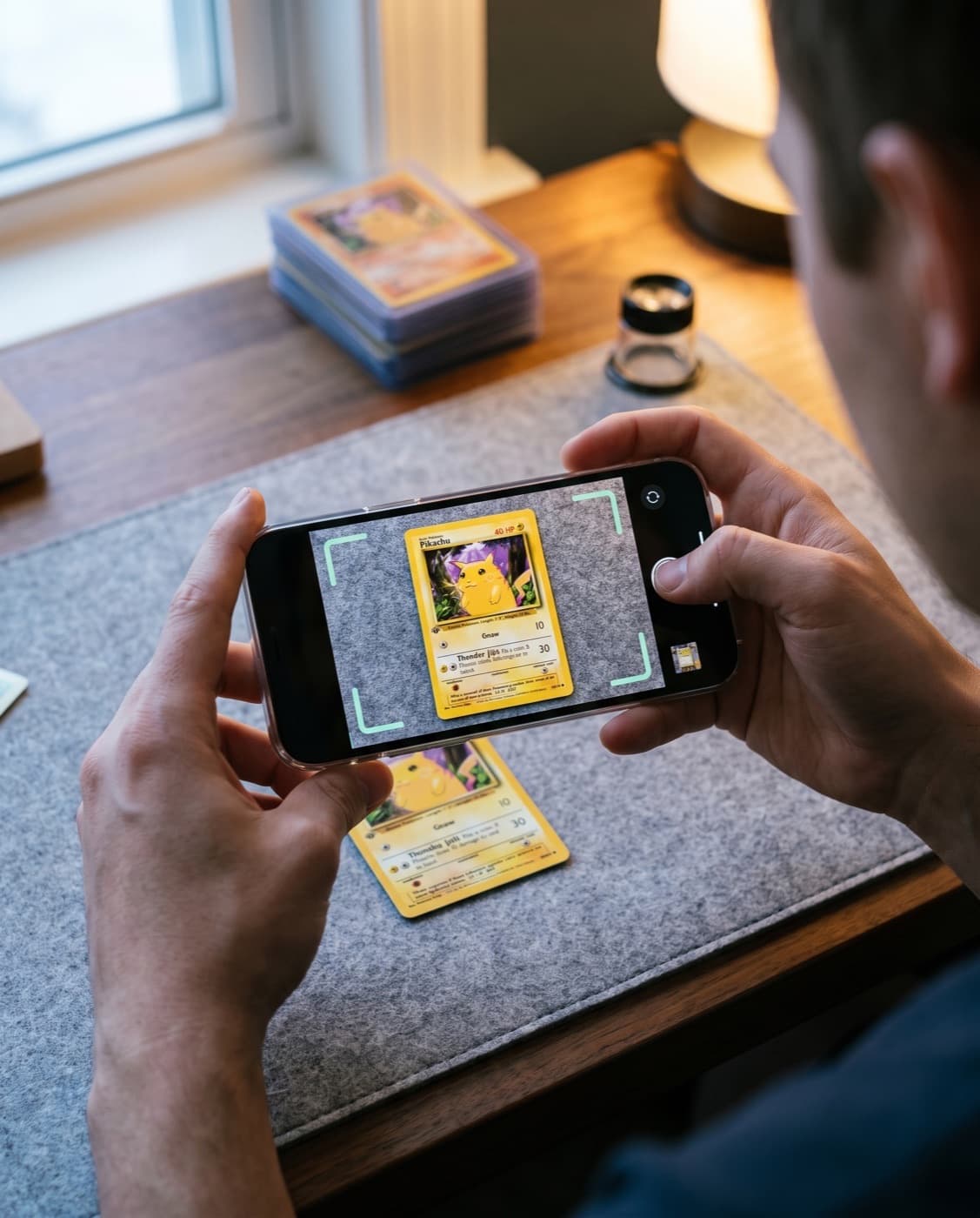
Show the front and back square on, in even light, with the corners visible. Buyers price the card they can see, so a blurry photo costs you money.
- Shoot on a plain dark background in daylight or under a soft lamp. Tilt the card slightly once to show the surface, and avoid flash glare.
- Photograph the actual card, never a stock image. For a slab, show the label and the cert number.
- Title it the way buyers search: name, card number, set, edition, language, then condition or grade.
- Describe flaws plainly. A buyer who finds a crease you didn’t mention will return the card or open a case.
How do you ship Pokémon cards safely?
Cheap cards can go in a plain white envelope; anything worth more needs a tracked bubble mailer. Either way, the card goes in a penny sleeve, then a top loader or semi-rigid holder.
- Plain white envelope (PWE): fine for cards worth a few dollars, with no tracking. A rigid holder can trigger a nonmachinable postage surcharge, so sandwich a sleeved card between cardboard instead.
- eBay Standard Envelope: eBay’s tracked letter service for raw single cards selling for $20 or less, much cheaper than a package label.
- Tracked bubble mailer: for everything else. Tape the top loader shut with painter’s tape, not regular tape, so the buyer can open it without damaging the card.
- Signature and insurance: add both on expensive cards. A lost $500 card with no signature is hard to win in a dispute.
Should you sell Pokémon cards raw or graded?
Grade first only when the card has a real chance at a grade that sells for well over the raw price plus fees. For most modern cards, selling raw clears more.
Grading costs real money: PSA’s cheapest open tier was $59.99 a card on 21 October 2026, before postage both ways, and a months-long wait (see our PSA grading cost breakdown). A PSA 10 of a popular card can sell for several times the raw price. A PSA 8 often sells for little more than a clean raw copy, and then the fee is lost. Graded cards also open doors raw cards don’t: Goldin and Fanatics Collect auctions, PSA Partner Offers and GameStop all want slabs.
So the honest test is the likely grade, not the best case. Our guide to whether grading is worth it works through the break-even, and where to get Pokémon cards graded compares the companies.
How do you avoid scams when selling Pokémon cards?
Keep the sale and the payment on the platform, and ship only to the address the platform gives you. Almost every scam starts by moving the deal somewhere with no protection.
- Ignore emails that say a payment is waiting. Check the platform’s own app or site before you ship.
- Refuse overpayments and requests to ship to a different address, a forwarder or a friend.
- Meet local buyers in a public place, ideally a police station safe-exchange spot, and count cash before you hand over the card.
- Film yourself packing anything valuable, and note any marks on the card or slab in the listing.
Questions people ask
Is it better to sell Pokémon cards on eBay or TCGplayer?
TCGplayer usually leaves a little more on modern raw singles, about $86 against $84 on a $100 card, and its buyers search by card number. eBay has more buyers for graded slabs, vintage and expensive cards, and its fee rate drops above $7,500.
How do you sell cards on TCGplayer?
Open a seller account, list each card against its catalog entry with its condition and price, and ship orders within the handling time. New sellers start at Level 1, which allows 100 items and $500 a card, and move up after orders reach their delivery date with good feedback.
Do pawn shops buy Pokémon cards?
Some do, but most pawn shops don’t specialize in cards and price them cautiously. A card shop, card show dealer or an online sale will usually pay more for anything valuable.
Where can I sell Pokémon cards for cash near me?
Local card and game shops, card shows and Facebook Marketplace pickups all pay cash the same day. If the card is PSA-graded in grade 8 to 10, many GameStop stores buy it too, up to $1,500 a card.
How do I tell if my Pokémon cards are worth money?
Look up recent sold prices for the exact card number, set, edition and language. Holos, 1st Edition vintage, full art and alternate art cards are the ones most often worth listing on their own; most commons sell only in bulk.
Sources
- eBay, Selling fees: trading card categories, per-order fee and how the total is defined (checked 21 October 2026)
- eBay, Authenticity Guarantee for trading cards: $200 threshold and terms (checked 21 October 2026)
- eBay, Introduces more affordable shipping for trading cards $20 and under (eBay Standard Envelope press release) (checked 21 October 2026)
- TCGplayer, TCGplayer Fees (checked 21 October 2026)
- TCGplayer, How do seller levels work? (checked 21 October 2026)
- Whatnot, Whatnot seller fees: US commission tiers and payment processing (checked 21 October 2026)
- Meta, Facebook Marketplace Seller Protection Policy: selling fee on shipped sales (checked 21 October 2026)
- PayPal, Merchant fees: receiving goods and services payments (checked 21 October 2026)
- PSA, PSA Partner Offers (checked 21 October 2026)
- PSA, Trading card grading service levels and prices (checked 21 October 2026)
- GameStop, Selling PSA graded cards FAQ (checked 21 October 2026)
- Goldin, FAQ: auction formats, seller fees and buyer’s premium (checked 21 October 2026)
- Fanatics Collect, Selling on Fanatics Collect: auction fees and Premier payouts (checked 21 October 2026)
- Fanatics Collect, Buy Now fees (checked 21 October 2026)
- Heritage Auctions, Why consign with Heritage (no published card commission) (checked 21 October 2026)
- Meta TCG, Pokémon bulk buylist rates (checked 21 October 2026)
Buddy is independent and isn’t affiliated with PSA, CGC, Beckett, TAG, SGC or The Pokémon Company. Fees and prices change; we re-check them when we update a guide.