On this page
The short answer
AI card grading uses computer vision to find a card’s edges in a photo, measure its borders for centering, and look for whitening, dings and scratches on the corners, edges and surface. From a phone photo it gives an estimate of the grade. Only a grading company, with the card in hand, gives the grade itself.
“AI grading” covers two different things, and most confusion about it comes from mixing them up. One is an app that reads photos you take at your desk. The other is a grading company that puts the card under its own cameras and lights. They use similar ideas, but they don’t see the same card. This guide explains what each one actually measures, what a phone photo can and can’t show, and how to take photos that give your card a fair reading.
What is AI card grading?
AI card grading is software that judges a card’s condition from images, using the same four things human graders look at: centering, corners, edges and surface. It turns up in two places.
- Who takes the imagesApp You, with your phoneGrader The grader, with its own cameras and lights
- What you getApp An estimate, in secondsGrader A grade, a slab and a certificate
- Card in hand?App NoGrader Yes
- Authenticity checked?App Not in the grading senseGrader Yes, before slabbing
- How long it takesApp SecondsGrader Days to months, plus shipping
| Question | Phone pre-grade app | Grading company with machine vision |
|---|---|---|
| Who takes the images | You, with your phone | The grader, with its own cameras and lights |
| What you get | An estimate, in seconds | A grade, a slab and a certificate |
| Card in hand? | No | Yes |
| Authenticity checked? | Not in the grading sense | Yes, before slabbing |
| How long it takes | Seconds | Days to months, plus shipping |
A pre-grade app is a sorting tool: it helps you decide which cards are worth sending in and which to leave raw. A grading company’s machine-vision system is part of how an official grade gets made. If you want to know whether submitting pays at all, is it worth grading Pokémon cards runs the numbers.
How does AI card grading work?
The software finds the card in the photo, straightens it, measures the borders, and then inspects each corner, edge and patch of surface for damage. Last, it holds what it found against each grading company’s published scale.
- Find the card’s outline. Edge detection picks out the four cut edges against the background. If you shot at a slight angle, the software warps the image back to a flat rectangle so a slanted photo doesn’t read as bad centering.
- Measure the borders for centering. It finds the printed frame inside the card and measures the border on each side. A left border of 2.2 mm and a right of 1.8 mm is 2.2 ÷ 4.0, or 55/45. It does the same top to bottom, front and back.
- Inspect the corners and edges. Each corner and edge is cropped and checked for whitening (pale card stock showing through the colored border), fraying, dings and chips. On Pokémon backs, white against the blue border stands out well.
- Scan the surface. The face is checked for scratches, print lines, specks, dents and creases. On holo and foil cards this is the hardest part, because the shine changes with every angle.
- Turn it into a grade. Each part is scored, then matched to each grader’s rules. That matters: the same measurements can be a 10 at one company and a 9 at another.
Centering is where machines are strongest, because it’s pure measurement. It’s also where the graders differ most, especially on the back. Here’s what each company needs for its Gem Mint grade.
- PSA 10 Gem MintFront 55/45Back 75/25
- CGC 10 Gem MintFront 55/45Back 75/25
- TAG 10 Gem MintStrictest backFront 55/45Back 65/35
- BGS 9.5 Gem MintFront 50/50 one way, 55/45 the otherBack 60/40
- SGC 10 Gem MintFront 55/45Back Not stated
| Grade | Front | Back |
|---|---|---|
| PSA 10 Gem Mint | 55/45 | 75/25 |
| CGC 10 Gem Mint | 55/45 | 75/25 |
| TAG 10 Gem MintStrictest back | 55/45 | 65/35 |
| BGS 9.5 Gem Mint | 50/50 one way, 55/45 the other | 60/40 |
| SGC 10 Gem Mint | 55/45 | Not stated |
A Pokémon card with a 70/30 back is still a possible PSA 10 but can’t be a TAG Gem Mint 10. That’s why a single “grade” from an app is less useful than a grade per company. Our Pokémon card centering guide shows how to measure it by hand, and the PSA grading scale covers every grade below 10.
What can a phone photo show, and what can’t it?
A sharp, flat, evenly lit photo shows centering, back-corner whitening and edge chips well. It struggles with light scratches on holo surfaces, shallow dents, and the tiny corner wear graders find under magnification.
- CenteringStrongIn a good phone photo Shows wellWhy It’s a measurement of borders, and borders photograph cleanly
- Whitening on back cornersIn a good phone photo Shows wellWhy Pale stock against the blue border has high contrast
- Edge chips and roughnessIn a good phone photo Mostly showsWhy Visible against a dark background
- Tiny corner frayIn a good phone photo Often hiddenWhy CGC judges Gem Mint corners under 10x magnification
- Light holo scratchesIn a good phone photo Often hiddenWhy They appear only when light hits at the right angle
- Shallow dentsIn a good phone photo Often hiddenWhy Flat light shows color, not shape
- Trimming or restorationIn a good phone photo Can’t tellWhy Needs the card in hand, measured and handled
| Flaw | In a good phone photo | Why |
|---|---|---|
| CenteringStrong | Shows well | It’s a measurement of borders, and borders photograph cleanly |
| Whitening on back corners | Shows well | Pale stock against the blue border has high contrast |
| Edge chips and roughness | Mostly shows | Visible against a dark background |
| Tiny corner fray | Often hidden | CGC judges Gem Mint corners under 10x magnification |
| Light holo scratches | Often hidden | They appear only when light hits at the right angle |
| Shallow dents | Often hidden | Flat light shows color, not shape |
| Trimming or restoration | Can’t tell | Needs the card in hand, measured and handled |
The surface is the real gap. A scratch on a holo is a groove that only lights up when the light catches it, so one photo taken with soft, even light can make a scratched card look clean, and a photo with a hot reflection can hide half the art. Grading companies get around this with their own hardware. TAG says it uses photometric stereo imaging, a technique that photographs the card under light from several directions so dents and scratches show up as shape, not just color. Your phone takes one photo from one angle.
Backs matter as much as fronts. Many collectors photograph only the front, but on a modern Pokémon card the back is often where the whitening and the off-center border are. A reading from the front alone is half a reading.
Do grading companies use AI to grade cards?
Some do. TAG and AGS build their grades on machine vision, and PSA bought a machine-vision company in 2021 to help its human graders. In each case the company owns the cameras and the lighting, so its system sees far more than a phone photo.
- TAGMachine Machine-learning software and photometric stereo imaging measure the card and score its defects on a 1000-point scaleLast word Human experts review every defect the system flags before the grade is final
- AGSMachine A “RoboGrading AI” system with imaging and laser scanning: one model measures centering, another maps defects, a third sets eight subgradesLast word AGS calls it a hybrid process; critical defects are reviewed by hand and can be overridden
- PSAMachine Bought Genamint in April 2021, whose system gives real-time measurements and diagnostics and helps detect alterationsLast word Human graders; PSA said at the time it was not taking people out of grading
| Company | What the machine does | Who has the last word |
|---|---|---|
| TAG | Machine-learning software and photometric stereo imaging measure the card and score its defects on a 1000-point scale | Human experts review every defect the system flags before the grade is final |
| AGS | A “RoboGrading AI” system with imaging and laser scanning: one model measures centering, another maps defects, a third sets eight subgrades | AGS calls it a hybrid process; critical defects are reviewed by hand and can be overridden |
| PSA | Bought Genamint in April 2021, whose system gives real-time measurements and diagnostics and helps detect alterations | Human graders; PSA said at the time it was not taking people out of grading |
TAG is the clearest example for Pokémon collectors. Its help center says it prefers the term “machine learning” to “AI,” and that every defect its system finds is reviewed by people before the grade is finalized. Its rubric weighs defects by size, depth and location, and counts flaws in and around a character’s face most. Our TAG grading guide covers its score bands and prices. AGS weights the front at 60% and the back at 40% to reach its final grade, and caps it at one point above the lowest subgrade.
Notice the pattern: even the companies that lead with machines keep people in the loop. Graders see things a camera setup can miss, and they make the judgment calls that scales leave open. PSA’s own standards allow “a small variance” in centering based on a card’s overall eye appeal, which is a human decision by design.
How is an AI pre-grade different from an official grade?
An official grade is a grading company’s judgment of the card in hand, sealed in a slab and backed by a certificate the market accepts. A pre-grade is a reading of your photos that tells you what that judgment is likely to be.
- The grader handles the card. It can tilt it under a lamp, use magnification and feel for bends. A photo is one fixed view.
- The grader checks authenticity. Trimming, recoloring and counterfeits are caught in hand. A photo app can compare print details, but it can’t measure a card’s thickness or feel its stock.
- The grader’s number has a price. Buyers pay for the label on the slab. No buyer pays more because an app said 10.
- The grader has discretion. Two graders can disagree on a borderline card, and the same card can come back differently on a resubmission. An app can’t predict that, only the odds.
Why is any AI grade only an estimate?
Because the grade often turns on a flaw too small or too dependent on light for a phone photo to settle. On modern Pokémon cards, the gap between a PSA 9 and a PSA 10 can be a single white speck on a back corner, and that gap is often worth hundreds of dollars.
That’s why an honest reading gives odds, not one number. A front that measures 55/45 sits right on PSA’s cutoff for a 10, where a fraction of a millimeter either way decides it, and the app should say so rather than pick a side. It should also say when a photo couldn’t show something, such as a holo surface washed out by glare, rather than calling it clean. Be wary of any tool, from any company, that gives a confident single grade from a blurry photo. The PSA 9 vs PSA 10 guide shows how much rides on that one step.
How do you take photos for an accurate AI grade?
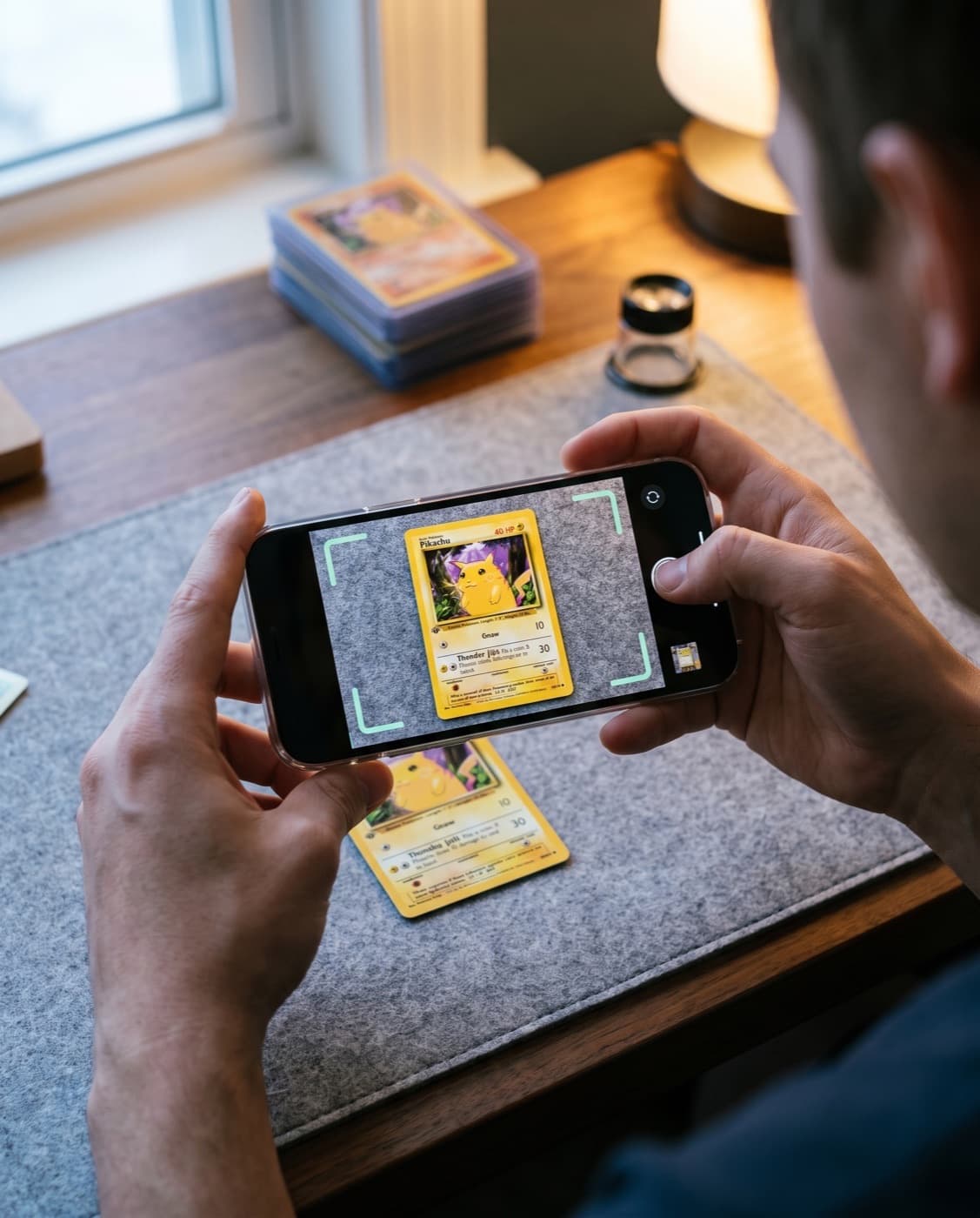
Shoot the card flat, out of its sleeve, on a plain dark background, in soft even light, with the phone held square above it. Then do the back the same way. Those few habits matter more than which app you use.
- Take the card out of its sleeve and top loader. Plastic adds reflections and its own scratches, and a sleeve’s edge can hide a corner. Handle the card by its edges.
- Lay it on a plain, dark, matte surface. A grey or black mat makes the cut edges and any white corner wear stand out. Avoid wood grain and patterned cloth.
- Use soft, even light from the side. Daylight from a window on an overcast day, or two lamps at either side at about 45 degrees. Turn the flash off: it puts a hot spot right on the holo.
- Hold the phone flat and square over the card. Line the phone up parallel to the card so all four corners are sharp and the borders look even. Fill most of the frame, but leave a little background on every side.
- Check the focus before you move on. Zoom into the photo and look at a corner. If the corner is soft, so is the reading. Wipe the lens and turn off portrait mode and filters.
- Photograph the back the same way. The back is graded too, and it’s where most Pokémon cards show whitening and off-center borders.
- For a holo, take one more photo at a tilt. Tip the card slowly under a single lamp until the light skims across the surface. Scratches and dents that vanish in flat light show up in that glancing reflection.
Is an AI card grader worth using?
Yes, as a filter before you pay to grade. A careful reading catches the cards that can’t get a 10, usually for centering or back whitening, and saves you a grading fee on each. It doesn’t replace looking at your best cards closely yourself.
It’s most useful in three places: sorting a stack of pulls down to the few worth submitting, choosing which company to send a card to when its back centering rules out one of them, and checking a raw card you’re thinking of buying from listing photos. In all three, the question isn’t “what grade is it” but “is the fee worth paying,” and that needs the odds, the fee and recent sale prices together.
Questions people ask
Is AI card grading accurate?
It is most reliable on centering, which is a measurement, and on clear whitening on back corners. It is least reliable on light surface scratches and small dents, which depend on how light hits the card. Treat any app’s result as odds, not a promise.
Can an app give my card an official grade?
No. Only a grading company such as PSA, CGC, Beckett, TAG or SGC can grade a card, because it examines the card in hand, checks that it is genuine and seals it in a slab with a certificate. An app gives an estimate from photos.
Does PSA use AI to grade cards?
PSA bought the machine-vision company Genamint in April 2021 to give its graders measurements and help spot altered cards. PSA said at the time that people would stay in the grading process, and its grades are still assigned by human graders.
Is TAG grading done by AI?
TAG uses machine-learning software and multi-angle imaging to find and score defects, and it prefers the term machine learning to AI. Its help center says human experts review every defect the system finds before a grade is finalized.
Why did my card grade lower than the app said?
Usually because of something a photo couldn’t show: a light scratch on a holo, a tiny corner fray under magnification, or a dent. Back flaws are another common cause when only the front was photographed. Grader judgment on borderline cards also varies.
Should I photograph my card in its sleeve?
No. A sleeve or top loader adds glare and its own scratches and can hide corners. Take the card out, handle it by the edges, and photograph it flat on a plain dark surface.
Sources
- TAG Grading help center, Does TAG use AI to grade cards? (checked 25 October 2026)
- TAG Grading help center, What are the steps of TAG’s grading process? (checked 25 October 2026)
- TAG Grading, Grading rubric: centering, defect scoring and Gem Mint 10 allowances (checked 25 October 2026)
- AGS, Grading standards: RoboGrading models, subgrades and final grade formula (checked 25 October 2026)
- Sports Collectors Digest, PSA acquires Genamint (21 April 2021; checked 25 October 2026)
- PSA, Grading standards: centering per grade and eye-appeal variance (checked 21 October 2026)
- CGC Cards, Grading scale: Pristine and Gem Mint 10, 10x magnification and centering (checked 25 October 2026)
- Beckett, Grading scale: centering per grade (beckett.com, archived 3 May 2026; checked 21 October 2026)
- SGC, Grading scale: centering per grade (checked 21 October 2026)
Buddy is independent and isn’t affiliated with PSA, CGC, Beckett, TAG, SGC or The Pokémon Company. Fees and prices change; we re-check them when we update a guide.