On this page
The short answer
A card centering tool measures the border on each side of a card and turns each pair into a ratio like 55/45: the wider border divided by both borders together. A PSA 10 needs 55/45 or better on the front and 75/25 on the back. On a modern Pokémon card, 55/45 is a shift of about a quarter millimeter.
Centering is the one part of a grade you can check at home with real numbers: measure four borders, do two divisions, compare with a table. The catch is scale. Pokémon borders are thin, so the gap between a 10 and a 9 is smaller than the marks on most rulers. Here’s how to measure it properly, which tools are up to the job, and the limits each grader publishes.
What does card centering mean?
Centering is how evenly the printed design sits between the card’s cut edges, written as a pair of percentages that add up to 100. A card with a 3 mm left border and a 2 mm right border is 60/40 left to right, because the left border is 60% of the 5 mm the two share.
PSA describes it plainly on its grading standards page: it compares the border measurements left to right and top to bottom, and records the centering at the most off-center part of the card. Three things follow from that.
- There are two ratios per side of the card, one left to right and one top to bottom, and the worse one counts.
- There are two sides. The front and back each have their own limits, and the card has to meet both.
- If the print sits at a slight angle, so a border is wider at one end than the other, the grader goes by the worst point, not an average.
So 50/50 is perfect, 55/45 slightly off, and 70/30 visibly lopsided from arm’s length.
How do you measure Pokémon card centering?
Get a flat, square image or a magnified view of the card, measure each border from the cut edge to where the printed design begins, and divide the wider border by the pair. Do it on both axes and both sides.
- Take the card out of its sleeve. Sleeve seams and toploader edges look like card edges in a photo and under an overlay.
- Get it flat and square. A flatbed scanner is best. With a phone, hold it directly above the card, card in the middle of the frame, and step back a little and zoom to 2x so the lens bends the edges less.
- Find the inner line of each border. On a modern card it’s where the silver border meets the yellow frame or the art. On the back it’s where the plain blue border meets the swirl pattern.
- Measure all four borders at both ends. If one end of a side is wider than the other, keep the worse reading. PSA goes by the most off-center part.
- Work out each ratio. Wider border ÷ (both borders) × 100 gives the first number; 100 minus it gives the second. Round to the nearest whole number.
- Take the worse axis on each side. Then look up the highest grade whose front limit your worst front ratio meets and whose back limit your worst back ratio meets.
A worked example
Here’s a pack-fresh modern card scanned at 600 dpi, where one pixel is about 0.04 mm. The front measures 2.85 mm on the left and 2.15 mm on the right, and 2.55 mm on top and 2.45 mm at the bottom.
The top and bottom are a near-perfect 51/49, but that doesn’t help: the worse axis decides, so the front is 57/43. That misses the 55/45 a Gem Mint 10 needs at PSA, CGC, TAG and SGC, and fits their 60/40 limit for a 9. At Beckett it also misses the 9, which wants 55/45 both ways, so on Beckett’s published scale centering alone puts the card at a BGS 8. A back at 70/30 would be fine for a PSA or CGC Gem Mint 10 but not for Beckett’s 9.5 (60/40) or TAG’s Gem Mint 10 (65/35), so at PSA it’s the front that holds this card back.
Notice how little separates 57/43 from a 10. The art would only need to move 0.1 mm to the left to reach 55/45.
How much is 55/45 in millimeters?
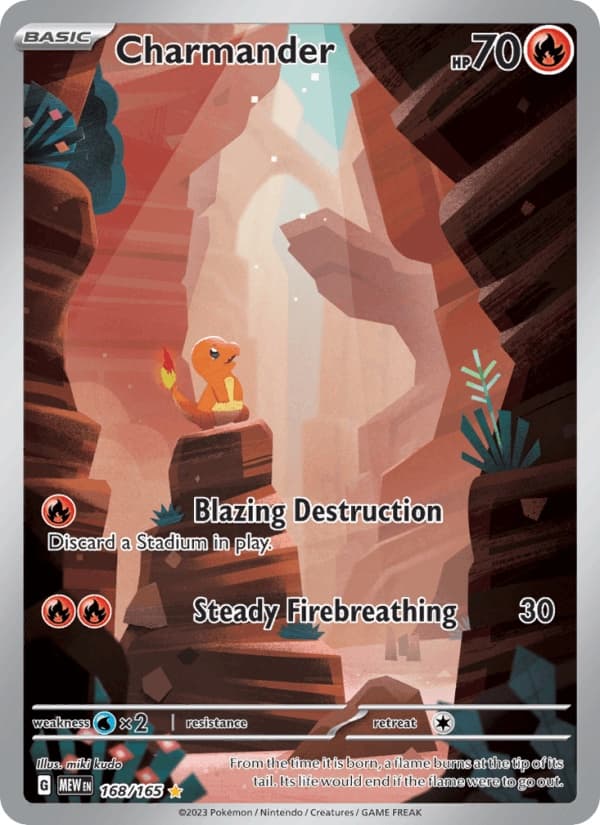
On a modern Pokémon card, about a quarter of a millimeter. We measured the silver border on the official Scarlet & Violet 151 images of the Pikachu common and the Charmander Illustration Rare: both are about 2.5 mm, so the left and right borders share about 5 mm. Here is what each grade limit allows on that card.
- 50/50Wider 2.50 mm · Narrower 2.50 mm0 mm
- 51/49 (TAG Pristine 10)Wider 2.55 mm · Narrower 2.45 mm0.05 mm
- 55/45 (PSA, CGC, TAG, SGC Gem Mint 10)PSA 10Wider 2.75 mm · Narrower 2.25 mm0.25 mm
- 60/40 (PSA, CGC, TAG, SGC 9)Wider 3.00 mm · Narrower 2.00 mm0.50 mm
- 65/35 (PSA 8)Wider 3.25 mm · Narrower 1.75 mm0.75 mm
- 70/30 (PSA 7)Wider 3.50 mm · Narrower 1.50 mm1.00 mm
| Ratio | Wider border | Narrower border | Print off center by |
|---|---|---|---|
| 50/50 | 2.50 mm | 2.50 mm | 0 mm |
| 51/49 (TAG Pristine 10) | 2.55 mm | 2.45 mm | 0.05 mm |
| 55/45 (PSA, CGC, TAG, SGC Gem Mint 10)PSA 10 | 2.75 mm | 2.25 mm | 0.25 mm |
| 60/40 (PSA, CGC, TAG, SGC 9) | 3.00 mm | 2.00 mm | 0.50 mm |
| 65/35 (PSA 8) | 3.25 mm | 1.75 mm | 0.75 mm |
| 70/30 (PSA 7) | 3.50 mm | 1.50 mm | 1.00 mm |
That is why the tool matters. A ruler marked in millimeters can’t tell 55/45 from 60/40 on a card this size: the whole difference is a quarter of one mark.
What centering do you need for a PSA 10 or a 9 at each grader?
For a PSA 10 you need 55/45 or better on the front and 75/25 on the back; for a PSA 9, 60/40 and 90/10. CGC matches PSA at 10 and 9, TAG and SGC match it on the front, and Beckett is the strictest of the five.
| Question | PSA | CGC | Beckett (BGS) | TAG | SGC |
|---|---|---|---|---|---|
| Top grade | 10 Gem Mint | 10 Pristine | 10 Pristine | 10 Pristine | 10 Pristine |
| Top grade, front | 55/45 | 50/50 | 50/50 all around | 51/49 | 50/50 |
| Top grade, back | 75/25 | Not stated | 60/40 | 52/48 | Not stated |
| Gem Mint, front | 55/45 (the 10) | 55/45 | 9.5: 50/50 one way, 55/45 the other | 55/45 | 55/45 |
| Gem Mint, back | 75/25 | 75/25 | 9.5: 60/40 | 65/35 | Not stated |
| Mint 9, front | 60/40 | 60/40 | 55/45 both ways | 60/40 | 60/40 |
| Mint 9, back | 90/10 | 90/10 | 70/30 | 75/25 | Not stated |
A few things the table hides. Beckett’s Gem Mint is a 9.5, not a 10, and it wants one axis dead center. TAG’s Pristine 10 allows only 51/49 on the front, a twentieth of a millimeter on a modern card. SGC gives one figure per grade and doesn’t say whether it covers the back. CGC’s Pristine 10 says “50/50” with no word on front or back. More on each company in our guides to Beckett grading and TAG grading.
PSA also builds in some give. Its off-center note says a 5% leeway on the front applies to cards that grade PSA 7 or better, and gives the example of a card that measures 65/35 and may still make a 9 if its eye appeal is good. Separately, a grader may allow a small variance on eye appeal. Treat both as a bonus, not a plan: a card that measures 57/43 should be priced as a PSA 9. The full grade-by-grade table is in our PSA grading scale guide.
Does back centering matter on Pokémon cards?
Yes, but it’s far more forgiving. PSA allows a 75/25 back on a 10 and 90/10 on a 9, against 55/45 and 60/40 on the front, so a back usually only costs a card its 10 when it’s badly off.
Measure the back the same way, from the cut edge to the inner line of the plain dark blue border, where the swirl pattern starts. Two cases to watch. At Beckett the back limits are 60/40 for a 9.5 and 70/30 for a 9, much closer to the front. And TAG’s Gem Mint 10 asks for 65/35 on a trading card back, tighter than PSA’s 75/25. A card with a 70/30 back is a PSA 10 candidate and a TAG 9 at best.
How is centering judged on full-art cards?
Exactly like any other card, because almost every full art still has a border. English cards since Scarlet & Violet have a thin silver border, full arts included; most older English cards have a yellow one, and gold cards a gold one.
On the official images, the Charmander Illustration Rare on the cover has the same 2.5 mm silver border as an ordinary Pikachu common from the same set, so the same limits and the same quarter of a millimeter apply. What changes is how hard the line is to find. When pale or grey art runs right up to a silver border, there’s little contrast, and it’s easy to measure to the wrong place. Measure along a stretch where the art next to the border is dark, and check the result on another stretch.
For the rare card with no printed border at all, none of the five graders publishes a separate rule. The closest is PSA’s note that when a border blends into the picture, poor centering “may not be much of an eyesore,” and a grader may make an exception on eye appeal. That leaves the front to the grader’s eye, while the back, with its standard blue border, is measured as usual.
Which card centering tool should you use?
A scan or a straight, sharp photo read in pixels is the most accurate, because it can resolve the quarter millimeter that decides a 10. A clear acrylic overlay is quick for sorting cards into “close” and “clearly off,” and a ruler only catches the bad ones.
- Millimeter rulerGood for Spotting 65/35 or worse · Watch out for Can’t separate a 10 from a 90.5 mm
- Measuring loupe with a 0.1 mm scaleGood for Checking one border at a time · Watch out for Slow; easy to misjudge the edge0.1 mm
- Clear acrylic overlayGood for Sorting a stack fast · Watch out for Lining up the card edge; viewing at an angleIts printed lines
- Phone photo and a calculator app or siteGood for Quick checks anywhere · Watch out for A tilted phone widens the near borderDepends on the photo
- Flatbed scan at 600 dpiMost accurateGood for The real answer before you pay to grade · Watch out for Sleeves and dust on the glass0.04 mm per pixel
| Tool | Resolves about | Good for | Watch out for |
|---|---|---|---|
| Millimeter ruler | 0.5 mm | Spotting 65/35 or worse | Can’t separate a 10 from a 9 |
| Measuring loupe with a 0.1 mm scale | 0.1 mm | Checking one border at a time | Slow; easy to misjudge the edge |
| Clear acrylic overlay | Its printed lines | Sorting a stack fast | Lining up the card edge; viewing at an angle |
| Phone photo and a calculator app or site | Depends on the photo | Quick checks anywhere | A tilted phone widens the near border |
| Flatbed scan at 600 dpiMost accurate | 0.04 mm per pixel | The real answer before you pay to grade | Sleeves and dust on the glass |
Overlays are what most people mean by a centering tool. The best known, the Legends Card Grading Centering Tool, is a clear acrylic sheet that sold for $7.99 on Envy Born Games’ site on 25 October 2026. You lay it over the card, line it up with the edges and read which marked lines the border falls between. The acrylic has thickness, so looking from slightly to the side shifts the lines, and a printed line is not much thinner than the 0.25 mm you’re judging. Use it to find the cards worth measuring properly.
Free calculator sites and apps take a photo, find the card’s edges or let you drag guide lines onto them, and do the division. They are only as good as the picture: a tilted phone makes the near border look wider than it is, and a soft photo blurs the line you’re measuring to. Shoot from directly above, card flat, in even light, and check the guides sit on the borders’ inner lines before you trust the number.
Is an off-center Pokémon card worth grading?
Sometimes, but price it at the grade the centering allows, not the grade the rest of the card deserves. A modern card at 58/42 is a PSA 9 at best on centering alone, however sharp its corners are.
When centering is the only thing holding a card back, PSA either gives it the grade its centering allows or adds an OC (off center) qualifier to the grade the rest of the card earned, such as “PSA 8 OC.” Either way the card won’t sell as a plain higher grade.
Whether that still pays depends on the gap between grades. On many modern chase cards a PSA 9 sells for little more than a clean raw copy, so a card that can’t reach a 10 often isn’t worth the fee; our PSA 9 vs PSA 10 guide shows by how much. Vintage is different: well-centered WOTC holos are scarce, and a 9 or 8 can still pay. Centering is one of four things graders check, so look over the rest with our Pokémon card condition guide before you decide.
So, which card centering tool is worth it?
Use an overlay or a ruler to sort, and a straight scan or photo measured in pixels to decide. Work out both axes on both sides, keep the worst reading, and compare it with the grader you’re sending to, since a card that is a PSA 10 on centering can be a BGS 8. If the numbers say 9, run the sum in is it worth grading Pokémon cards with a 9 as the likely result before you pay to find out.
Questions people ask
What is 60/40 centering?
It means the wider border on one axis is 60% of the two borders together and the narrower one 40%. On a modern Pokémon card that’s a 3.0 mm border against a 2.0 mm one, and it’s the front limit for a 9 at PSA, CGC, TAG and SGC.
Is 55/45 centering good enough for a PSA 10?
Yes. PSA’s standard for a 10 is approximately 55/45 or better on the front and 75/25 on the back. Everything else on the card still has to meet the 10 standard too.
Can an off-center card get a PSA 10?
Not if it’s clearly off. PSA allows a grader some leeway when a card’s eye appeal is strong, but a card past 55/45 on the front should be planned as a 9, and one well past it may come back with an OC qualifier.
Do graders check centering on the back of Pokémon cards?
Yes. PSA, CGC, Beckett and TAG all publish back limits, and they are looser than the front at every company. SGC publishes one figure per grade without saying whether it covers the back.
Are centering apps accurate?
They can be accurate to a fraction of a millimeter if the photo is flat, sharp and taken from directly above. A soft, tilted or cropped photo throws the reading off, and a few tenths of a millimeter is enough to turn a 10 into a 9 on paper.
Can you fix bad centering?
No. Centering is fixed when the card is cut at the factory, and trimming a card to even out its borders is alteration. PSA won’t grade a trimmed card, and it still charges the fee.
Sources
- PSA, Grading standards: PSA 10 and 9 centering, the OC qualifier, eye appeal and the centering note (checked 25 October 2026)
- CGC Cards, Grading scale: Pristine 10, Gem Mint 10 and Mint 9 centering (checked 25 October 2026)
- TAG, Grading rubric: Pristine 10, Gem Mint 10 and Mint 9 centering for TCG cards (checked 25 October 2026)
- Beckett, Grading scale: centering per grade, Internet Archive copy of 3 May 2026 (read 25 October 2026; beckett.com blocks automated checks)
- SGC, Card grading scale (read 21 October 2026; behind a bot check on 25 October 2026)
- TCGdex, official card images: Pikachu 025/165 and Charmander 168/165, Scarlet & Violet 151, used to measure border widths (25 October 2026)
- CardCodex, Standard vs jumbo Pokémon card sizes: 63 × 88 mm; secondary source (checked 25 October 2026)
- Envy Born Games, Legends Card Grading Centering Tool, $7.99 (checked 25 October 2026)
Buddy is independent and isn’t affiliated with PSA, CGC, Beckett, TAG, SGC or The Pokémon Company. Fees and prices change; we re-check them when we update a guide.