On this page
The short answer
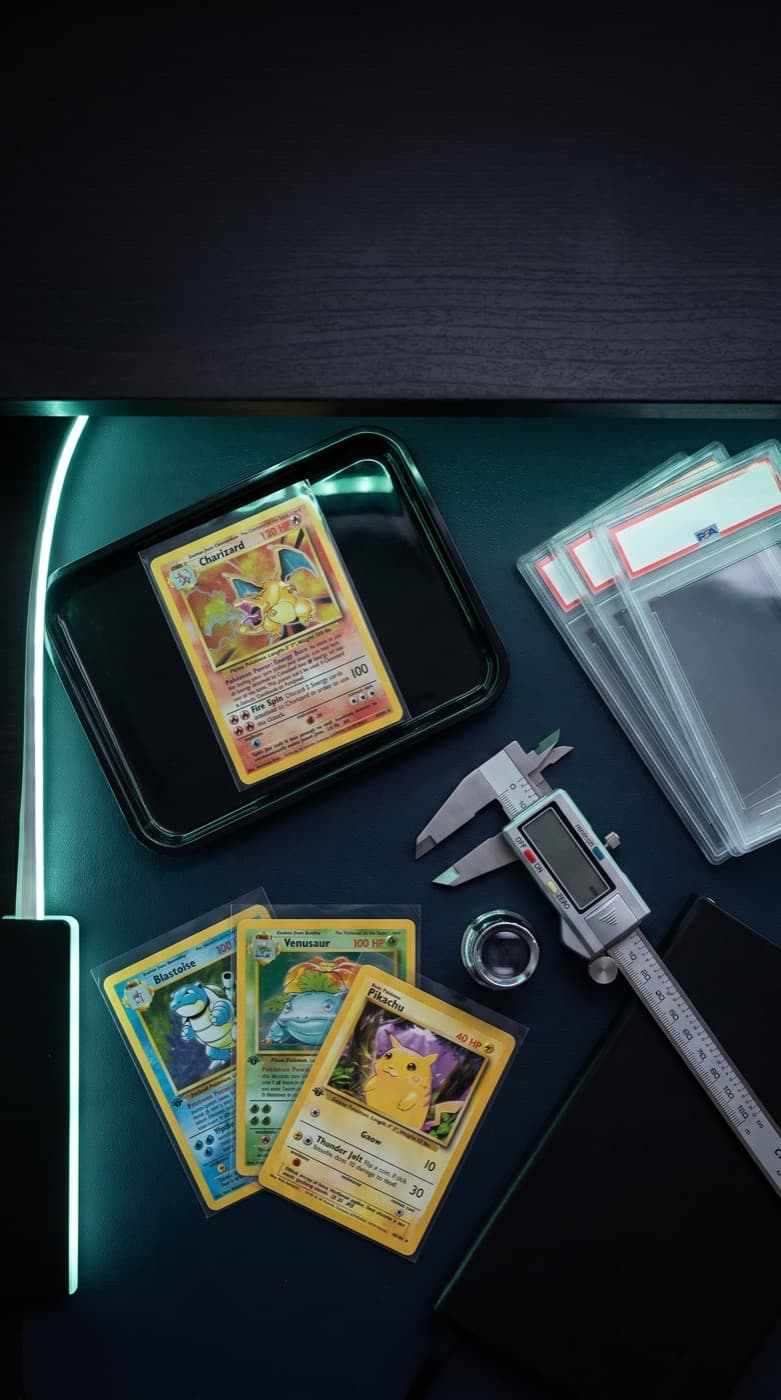
Store Pokémon cards in layers matched to their value: a clear, PVC-free penny sleeve on anything worth keeping, then a top loader or semi-rigid holder for cards worth about $20 or more, and a side-loading binder or upright box for the rest. Keep them in a dry, dark room at a steady temperature, never an attic, basement or garage.
Most storage advice treats every card the same. That’s how you end up with a $2 common in a magnetic case and a $300 chase card dented in a ring binder. Protect hardest the card with the biggest gap between its raw price and its PSA 10 price, because one dent or whitened corner closes that gap for good.
What is the best way to store Pokémon cards to keep them safe?
Sleeve first, hold second, house third, and control the room around all of it. Each layer stops a different kind of damage, so skipping one leaves a gap the others don’t cover.
- Sleeve the card the moment it leaves the pack. A clear penny sleeve keeps fingerprints, dust and surface scuffs off the holo and the back. Slide it in top first so the corners don’t catch on the opening.
- Add a rigid or semi-rigid holder for anything valuable. A top loader or semi-rigid holder stops bends and corner knocks. The sleeve stays on inside it.
- House it so nothing presses on it. Side-loading binder pages, a card storage box or a slab box, stored upright like books rather than stacked flat under weight.
- Keep the room steady. Cool, dry and dark, away from outside walls, windows, radiators and vents. Swings in humidity are what warp foil cards.
What are penny sleeves, top loaders and semi-rigids for?
Sleeves protect the surface, holders protect the shape, and binders and boxes keep everything organized and out of harm’s way. The table sorts every common storage product by what it actually does.
- Penny sleeveAlwaysWhat it stops Fingerprints, dust, surface scuffsBest for Every card worth more than bulkWatch out for Cheap PVC sleeves; cards forced in corner first
- Perfect-fit inner sleeveWhat it stops Dust getting in from the open endBest for Long-term storage, double sleevingWatch out for Too tight to slide out without bending
- Top loader (rigid)What it stops Bends, creases, corner knocksBest for Cards worth about $20 and upWatch out for Tape over the opening; card loose without a sleeve
- Semi-rigid holderWhat it stops Bends, with an easy way outBest for Cards going to a graderWatch out for Too flexible to stack heavy things on
- Magnetic one-touch caseWhat it stops Bends, scratches, dust, with displayBest for Cards worth a few hundred dollars and upWatch out for Wrong thickness size; opening it often
- Side-loading binder pageWhat it stops Bends and dust, with easy viewingBest for Sets and collectionsWatch out for Overstuffing; ring binders that press the inner row
- Card storage boxWhat it stops Crushing and lightBest for Bulk and sleeved commonsWatch out for Packing too tight or too loose so cards slide
| Layer | What it stops | Best for | Watch out for |
|---|---|---|---|
| Penny sleeveAlways | Fingerprints, dust, surface scuffs | Every card worth more than bulk | Cheap PVC sleeves; cards forced in corner first |
| Perfect-fit inner sleeve | Dust getting in from the open end | Long-term storage, double sleeving | Too tight to slide out without bending |
| Top loader (rigid) | Bends, creases, corner knocks | Cards worth about $20 and up | Tape over the opening; card loose without a sleeve |
| Semi-rigid holder | Bends, with an easy way out | Cards going to a grader | Too flexible to stack heavy things on |
| Magnetic one-touch case | Bends, scratches, dust, with display | Cards worth a few hundred dollars and up | Wrong thickness size; opening it often |
| Side-loading binder page | Bends and dust, with easy viewing | Sets and collections | Overstuffing; ring binders that press the inner row |
| Card storage box | Crushing and light | Bulk and sleeved commons | Packing too tight or too loose so cards slide |
Should you double sleeve Pokémon cards?
For storage, double sleeving is worth it on cards you plan to keep for years. Put the card in a perfect-fit inner sleeve upside down, so its open end is at the bottom, then slide that into a regular sleeve right side up. The two openings face opposite ways, which seals out dust and moisture far better than one sleeve. Take the inner sleeve off before you send a card to be graded; the graders below ask for a single clear sleeve.
Are PVC sleeves bad for cards?
Yes, for anything you keep long term. Conservators avoid PVC because it is chemically unstable: Cornell University Library’s preservation guide warns that PVC gives off hydrochloric acid when warm and turns brittle as its plasticizers separate. The safe plastics for storage are polypropylene, polyester and polyethylene. Old vinyl binder pages from the 1990s are the usual culprit, so if your vintage cards still live in sticky, cloudy, chemical-smelling pages, move them.
How should you store Pokémon cards by value?
Spend on protection in proportion to what the card could lose. Bulk needs a box; a card that could grade a 10 needs a sleeve and a holder from the moment it’s pulled.
- Bulk (under about $1)Store it in Unsleeved in a card storage box, upright, with dividersWhy Sleeves cost more than the cards; a snug box stops bending
- Around $1 to $20Store it in Penny sleeve, then a side-loading binder or a boxWhy Surface scuffs are the main risk, and you’ll want to look at them
- Around $20 to $100Top loader lineStore it in Penny sleeve and top loader, filed upright in a boxWhy A bend or soft corner now costs real money
- Around $100 to $1,000Store it in Penny sleeve and top loader or semi-rigid; magnetic case for displayWhy These are the cards most likely worth grading
- $1,000 and upStore it in Penny sleeve and magnetic case, or graded; in a closed box in a steady roomWhy Here a single dent can cost hundreds of dollars
| Card value | Store it in | Why |
|---|---|---|
| Bulk (under about $1) | Unsleeved in a card storage box, upright, with dividers | Sleeves cost more than the cards; a snug box stops bending |
| Around $1 to $20 | Penny sleeve, then a side-loading binder or a box | Surface scuffs are the main risk, and you’ll want to look at them |
| Around $20 to $100Top loader line | Penny sleeve and top loader, filed upright in a box | A bend or soft corner now costs real money |
| Around $100 to $1,000 | Penny sleeve and top loader or semi-rigid; magnetic case for display | These are the cards most likely worth grading |
| $1,000 and up | Penny sleeve and magnetic case, or graded; in a closed box in a steady room | Here a single dent can cost hundreds of dollars |
Value is only half the test. A $40 card that is centered and clean enough for a PSA 10 deserves better storage than a $60 card with a soft corner, because the first one has a grade to lose. Here’s how big that gap can be on one of the most traded modern cards.
Those are TCG Charts’ current prices for the Scarlet & Violet 151 Charizard ex on 25 October 2026, and they move week to week. The shape is the point: a PSA 9 sells for little more than a raw copy, and the 10 sells for about four times as much. A card in that position should never touch a binder ring. The PSA 9 vs PSA 10 guide explains what separates the two, and what your Pokémon card is worth shows how to find the raw price for your own cards.
Are binders safe for Pokémon cards?
Yes, if the pages load from the side and nothing presses on the cards. Ring binders and overstuffed binders are where most binder damage comes from.
- Side-loading pockets. Cards that go in from the top can slide out when the binder tips. Side-loading pockets hold them in place.
- No O-rings. In a round-ring binder the pages curve around the rings and the cards in the column nearest the spine get pressed into a dent. Zippered binders with sewn-in pages avoid this; a D-ring binder with the rings on the back cover is the next best thing.
- One card per pocket. Two cards back to back in one pocket rub against each other and stretch the pocket.
- Don’t overfill. A binder that won’t close flat is squeezing the cards near the spine. Leave the last few pages empty.
- Store it standing up. Upright on a shelf, like a book. A binder lying flat under other binders slowly presses every card in it.
What temperature and humidity should Pokémon cards be stored at?
Room temperature or a little below, relatively dry, and above all steady. The Library of Congress recommends storing paper in a cool, stable room at about 35% relative humidity, with as little light as possible.
Cards are paper and ink, so the same rules apply. Damp is the bigger danger: the Canadian Conservation Institute’s tables put visible mold at about 100 days at 70% relative humidity on vulnerable surfaces, and about 10 days at 80%. Clean paper holds out longer, but staining comes first and costs a grade on its own. Dry air on its own is less of a threat than air that keeps changing.
- Pick an inside room. A closet or shelf on an interior wall stays steadier than one on an outside wall. The Library of Congress says to avoid attics and basements; garages swing even more.
- Keep it dark. Sunlight and strong lamps fade the inks over time. Closed boxes beat a sunny shelf, and display cases should sit away from windows.
- Watch the humidity, not just the temperature. A cheap hygrometer in the closet tells you more than the thermostat. If it sits in the 60s for weeks, add a dehumidifier or a sealed box with fresh desiccant packs.
- Let cards settle after a move. Bring a box in from a cold car or a hot mail truck and leave it closed for a few hours before you open it, so moisture doesn’t condense on the cards.
Why do holo Pokémon cards curl?
Collectors widely put it down to humidity. A holo or full-art card is paper bonded to a foil layer, and the paper takes on and gives up moisture while the foil doesn’t, so the card bows. It often relaxes again once it sits in a steady room in a snug top loader for a while. Don’t press it under books or heat it: PSA’s grading standards list crease or wrinkle pressing as an alteration, and an altered card comes back with no grade at all.
What storage mistakes cost cards a grade?
Almost every storage mistake shows up as an edge dent, a soft corner or a surface mark, and those are exactly what graders look for. PSA allows only a slight printing flaw on a 10, and on its scale a single light crease drops a card to a 4.
- Rubber bands straight on cards. They dent the edges of the top and bottom cards in the stack and can leave marks as they age. Band a stack of holders between two pieces of cardboard, never the cards themselves.
- Tape on top loaders. Tape seals the card in, so you end up pulling or cutting to get it out, and the adhesive creeps onto the sleeve or the card. If you need to close a holder, use a sleeve or a resealable bag around the whole holder.
- No sleeve inside the top loader. A bare card slides around in a top loader and the rigid edge scuffs its corners. The sleeve also makes the card easy to get out.
- Forcing a card into a tight sleeve or holder. Corners catch and fold on the way in. If it doesn’t slide, use a bigger size.
- Overstuffed binders and round-ring binders. Both press a ridge into the cards nearest the spine.
- Stacking boxes and binders flat. The weight presses the cards at the bottom. Stand them upright.
- Writing on or sticking notes to the sleeve. Pen pressure dents the card through the sleeve, and sticky notes leave residue.
- Wiping cards to clean them. A dry cloth drags grit across the surface, and PSA counts any foreign substance on a card, such as cleaning spray, as an alteration. Read how to clean Pokémon cards before you try.
How do grading companies want cards packed?
In a clear penny sleeve inside a semi-rigid holder, not a top loader. PSA and TAG both say so outright, and CGC asks for a semi-rigid sleeve sturdy enough for its staff to remove the card safely.
| Question | PSA | CGC | TAG |
|---|---|---|---|
| Inner sleeve | Clear penny sleeve; no solid or opaque sleeves | A protective sleeve | A soft sleeve |
| Holder | Semi-rigid, 3 5/16 x 4 7/8 in | Semi-rigid, sturdy enough to remove the card safely | Semi-rigid, 3 5/16 x 4 7/8 in |
| Top loaders | Not allowed | Not mentioned | Not allowed, nor magnetic cases |
| Tape or notes on holders | No tape, pull tabs or sticky notes | Not mentioned | No tape or stickers |
| The stack | Between cardboard, 2–3 rubber bands | Between cardboard, rubber bands snug not tight | Between cardboard, painter’s tape or rubber bands |
None of them explains why top loaders are out, but every card has to come out of its holder to be graded, and a card slides out of a flexible semi-rigid far more easily than out of a rigid top loader. That’s the real case for keeping a few semi-rigid holders on hand: a card that might be graded can live in one from the start. Notice too that the rubber bands go around the cardboard and the holders, never the cards. The full process, with tiers and order stages, is in how to submit cards to PSA.
How do you store graded Pokémon cards?
Upright in a box made for slabs, out of direct light. A slab protects the card from handling, but the plastic itself scratches, and a scratched slab is harder to sell even with a perfect card inside.
- Stand slabs on edge in a slab box rather than stacking them face to face, where grit between them scratches the plastic.
- Keep them out of sunlight like raw cards. The label and the card can still fade behind clear plastic.
- Note each certification number somewhere separate, so you can prove what you own if anything goes missing.
So how should you store your Pokémon cards?
Put a PVC-free penny sleeve on anything worth more than bulk, a holder on anything worth about $20 or with a shot at a high grade, and keep it all upright in a dry, dark, steady room. Skip ring binders, rubber bands and tape. And before you file away a card you might grade, check it once, because storage can only keep the condition it already has. If it looks like a 10, the PSA grading scale and is it worth grading are the next two reads.
Questions people ask
Should I put my Pokémon cards in top loaders?
Put cards worth about $20 or more in a penny sleeve and then a top loader, and keep cheaper cards in sleeves in a binder or box. If you plan to send a card to PSA or TAG, move it to a semi-rigid holder first, because both say not to send top loaders.
Are penny sleeves enough to protect Pokémon cards?
They protect the surface from fingerprints and scuffs, but not from bending. A sleeved card in a binder or a snug box is fine for everyday cards; a valuable card needs a top loader, semi-rigid or magnetic case as well.
Can I keep Pokémon cards in the tin they came in?
For bulk, yes, as long as the cards fit snugly and stand upright so they can’t slide and knock their edges. For anything valuable, use sleeves and holders in a proper card box, and keep tins out of damp places where metal can rust.
Is it bad to keep Pokémon cards in a binder?
No, if it’s a side-loading binder with sewn-in pages or D-rings, one card per pocket, not overfilled and stored upright. Round-ring binders and overstuffed binders press dents into the cards nearest the spine.
Do Pokémon cards need to be kept in the dark?
Out of direct sunlight and strong light, yes. Light fades the inks over time. Closed boxes and binders on a shelf are enough; a display case is fine if it’s away from windows.
Can I store Pokémon cards in a garage or basement?
It’s best not to. Garages and attics swing in temperature and basements tend to be damp, and humidity is what warps holo cards and brings mold. An interior closet in the main part of the house is far safer.
Sources
- PSA, Shipping Guide: sleeves, semi-rigid holders, no top loaders or tape (checked 25 October 2026)
- PSA, Grading standards: grade definitions and the N5 altered-stock designation (checked 25 October 2026)
- CGC Cards, Shipping your cards: packaging instructions (checked 25 October 2026)
- TAG Grading, How do I mail cards to TAG without using a submission kit?, dated 24 June 2026 (checked 25 October 2026)
- Library of Congress, Care, handling and storage of works on paper (checked 25 October 2026)
- Canadian Conservation Institute, Agent of deterioration: incorrect relative humidity (checked 25 October 2026)
- Cornell University Library, Preservation tutorial: stabilization and housing, on PVC and safe plastics (checked 25 October 2026)
- TCG Charts, Charizard ex #199 (Scarlet & Violet 151) raw, PSA 9 and PSA 10 prices (checked 25 October 2026)
- Elite Fourum, Do only holographic cards curve?; collector discussion of foil and humidity, secondary source (checked 25 October 2026)
Buddy is independent and isn’t affiliated with PSA, CGC, Beckett, TAG, SGC or The Pokémon Company. Fees and prices change; we re-check them when we update a guide.