On this page
Beckett grading costs between $14.95 and $124.95 per card on the tcgrader.com price table, with the cheapest Base tier at $14.95 and Base with Subgrades at $17.95, so subgrades add about $3 per card at entry level1. Higher tiers move fast: the same table lists Standard at $34.95, Express at $79.95 and Priority at $124.951. Prices below were read in November 2026 and Beckett changes them, so check its own page before you submit.
Beckett tier prices, subgrades and turnaround
The tcgrader.com comparison lists five Beckett (BGS) tiers with no declared-value cap, and the only price difference it flags between plain and subgrade grading is at the Base level1. Here is that table, as read in November 2026:
| Tier | Fee per card | Est. turnaround | Max card value |
|---|---|---|---|
| Base | $14.95 | ~3 months | No cap |
| Base with Subgrades | $17.95 | ~3 months | No cap |
| Standard | $34.95 | ~2 months | No cap |
| Express | $79.95 | ~15 days | No cap |
| Priority | $124.95 | ~5 days | No cap |
Source: tcgrader.com's account of Beckett's pricing1. That site notes that subgrades cost extra and that "the classic BGS look most buyers expect includes them"1.
Other sites quote different numbers. PreGradeCards, writing in June 2026, lists Base at $20, Standard at $35, Express at $75 and Priority at $125, with value caps of $500 to $10,0002. The gap shows why a third-party table is a starting point, not a quote. Beckett's own tier page is the figure that bills you.
What the subgrades are and why they cost extra
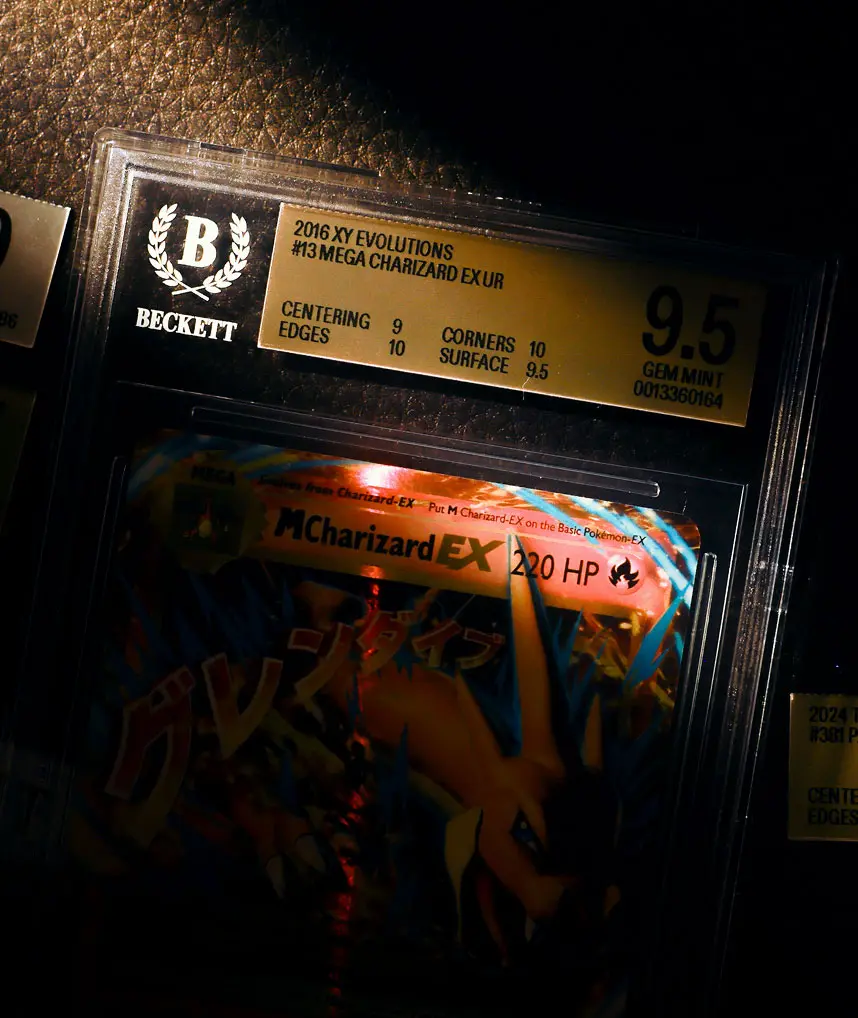
A subgrade splits a card's condition into four scores: centering, corners, edges and surface. PreGradeCards describes BGS as having pioneered this approach, which is the main way Beckett differs from PSA's single overall grade2. TNT Cards, a submission service, says subgrades "can provide additional insight into your card's centering, corners, edges, and surface," and that some collectors skip them to save money3.
The overall grade follows the subgrades. PreGradeCards says the overall cannot exceed the lowest subgrade by more than one point, so a single 8.5 subgrade caps the card at 9.02. The same source says a Black Label 10 needs four 10 subgrades and that PSA 10 premiums can be exceeded by 2 to 5 times for those cards, though that is one vendor's claim about market prices2.
So the extra $3 at the Base tier buys you the four scores that make a card a BGS card in most buyers' eyes. If you plan to sell, that looks like a cheap addition. If you only want a protective slab and an authenticity record, plain grading is cheaper.
What changes your total
The per-card fee is only part of the bill, and several factors move the final number.
Declared value and upcharges
Beckett prices by declared value in some tables, and PreGradeCards warns that if BGS decides the card is worth more than you declared, it may upcharge you2. CGC states the same rule on its own services page: if it decides a collectible's fair market value is higher than stated, it moves the card to the higher tier and the extra charge falls on the submitter4. Declare honestly. A cheap tier with a wrong value is not actually cheap.
Autographs and oversized cards
TNT lists a BGS Express service at $100 per card with subgrades and about one month of turnaround, with $5 added for an autograph and $10 for an oversized card3. That is a different figure from the tcgrader.com $79.95 Express price, so quotes vary by where you read them and when.
Shipping, insurance and supplies
CardValueFinder estimates round-trip shipping, insurance and packing supplies add $30 to $70 per submission batch, and it breaks that into $10 to $30 outbound, $15 to $40 return, $5 to $50 or more for insurance, and $5 to $15 for supplies5. Its worked example: five cards at $25 each plus $20 outbound and $25 return shipping comes to about $170, or $34 per card instead of $255. The same logic applies to a single Beckett card. A $17.95 slab can cost $40 or more all in.
Third-party submission fees
TNT says submitting through it does not change Beckett's own fees. Its added services run from no extra charge for an unreviewed drop-off, to $1 per card for prep and send, $4 for a pass/fail review and $6 for a detailed review3. TNT also says its total is slightly higher than direct submission, though lower shipping costs often make the overall cost comparable3.
How Beckett compares with PSA, CGC and TAG
Beckett's Base fee of $14.95 is the lowest entry price of the four majors on the tcgrader.com table, and its turnaround is slow at about three months1. Here is how the other three major graders price their cheapest and fastest options, as each company states or as tcgrader.com reports:
| Grader | Cheapest listed tier | Fast tier |
|---|---|---|
| PSA | Value Bulk $39.99, currently paused; Regular $79.996 | Super Express $349, 10 to 15 business days6 |
| CGC | Bulk Economy $17, minimum 25 cards4 | WalkThrough £288, 2 business days4 |
| TAG | Basic $22 (paused when read)1 | Walkthrough $299, about 3 days1 |
| Beckett | Base $14.951 | Priority $124.95, about 5 days1 |
Prices checked on 6 Nov 2026.
PSA's own page says its Value services are temporarily paused, so the cheapest advertised price may not be one you can use6. Misprint's TAG comparison quotes TAG at $12 to $15 per card at the economy end7. Pricing across all of these moves, so treat the table as a snapshot.
For head-to-head detail, see Beckett against PSA on which company to submit to, and for tier-by-tier PSA numbers read PSA, BGS, CGC and TAG fees side by side.
How to decide which Beckett tier to pay for
Start from the card's likely grade and value, not the fee. CardValueFinder gives a simple test: grading is worth it when the graded value minus the raw value is greater than total grading cost, where total cost is the grading fee plus shipping out, return shipping and insurance5. It also notes that a PSA 9 instead of a 10 can leave a card worth less than the all-in cost5. The same maths applies to a BGS 9 against a 9.5.
A workable order of steps:
- Find the raw price and the price of the grade you expect from recent sold listings.
- Add the grading fee for the tier whose value cap and turnaround suit the card.
- Add $30 to $70 for shipping, insurance and supplies if you are sending a small batch.
- Decide whether the subgrade add-on is worth it for resale. At Base level that is about $3.
- Submit only if the gap clears the total, with room for a grade below your hope.
This is where Buddy fits. You photograph the card in Buddy and it estimates the odds of each grade from Beckett, PSA, CGC, TAG and SGC, and measures centering against grader standards for a possible 10. It also checks the card for fakes and shows pricing from real sales on eBay and TCGplayer. You see the estimated grade and value before you choose a tier or pay a fee, which tells you whether the gap in step 5 is real.
If you want to compare tools, apps that estimate a grade before you submit covers the main options.
Common mistakes with Beckett pricing
The most common mistake is treating the lowest advertised fee as the price you pay. The tcgrader.com comparison warns that "the cheapest advertised price often isn't actually available" because paused and sold-out tiers exist across graders1.
- Underdeclaring value. Beckett and CGC both reserve the right to move a card to a higher tier and bill the difference24.
- Forgetting the subgrade fee. A $14.95 Base card without subgrades looks different from the $17.95 version most buyers expect1.
- Ignoring shipping. Tracked, insured postage to and from the grader typically adds $15 to $40 per submission, which is brutal on a single card1.
- Submitting a card that will not grade well. Fees are the same whether the card comes back a 7 or a 10. TNT notes that for no-review orders every card is submitted as received, and once a card is with BGS the grade is decided by BGS alone3.
- Assuming a third-party site's table is current. PreGradeCards and tcgrader.com list different Beckett prices, so confirm against Beckett before you pay21.
For the standards behind the numbers, Beckett's grading standards and subgrade rules goes through what each subgrade measures.
Frequently asked questions
How much does Beckett card grading cost with and without subgrades?
On the tcgrader.com price table, Base grading is $14.95 per card and Base with Subgrades is $17.95, both at about three months turnaround1. Faster tiers run $34.95 for Standard, $79.95 for Express and $124.95 for Priority1. Beckett's own page is the figure that bills you.
Does Beckett grading upcharge?
Yes, it can. PreGradeCards says that if BGS decides your graded card is worth more than you declared, it may upcharge you2. Declare the card's true value to avoid a bill after grading.
Is Beckett grading worth it?
It depends on the gap between the graded and raw value. CardValueFinder's test is that grading pays when the graded value minus the raw value is greater than the fee plus shipping, return shipping and insurance5. Estimating the grade first, in Buddy for example, shows whether the card is likely to clear that bar.
How does Beckett grading cost compare with PSA?
Beckett's $14.95 Base fee is the lowest entry price of the four majors on the tcgrader.com table1. PSA's own page lists Regular at $79.99 and says its Value services are temporarily paused6. Beckett's cheap tiers are slow, about three months for Base1.
Do I pay more to submit Beckett cards through a third party?
TNT Cards says submitting through it does not change BGS fees, and that its own support runs from no extra charge to $6 per card for a detailed review3. It adds that reduced shipping costs often make the overall cost comparable to direct submission3.
Sources
- 1Beckett prices, per tcgrader.com: How much does card grading cost in 2026?tcgrader.com
- 2BGS Grading: The Complete 2026 Guidepregradecards.com
- 3Beckett Card Gradingtntcards.com
- 4CGC prices: Services & Feescgcgrading.com
- 5SGC prices, per cardvaluefinder.com: The Grading Premium: Real Examplescardvaluefinder.com
- 6PSA prices: Gradingpsacard.com
- 7TAG prices, per misprint.com: PSA vs TAG: Is TAG Worth It Yet?misprint.com
Buddy is independent and isn’t affiliated with PSA, CGC, Beckett, TAG, SGC or The Pokémon Company. Fees and prices change; check the sources for the latest.