On this page
The short answer
A Pokémon card show is an event where dealers rent tables to buy, sell and trade cards. Find them through organizers’ sites, Facebook groups, card show calendars and your local card shop. Bring cash, a loupe, a small light and sold prices on your phone. Dealers price near market and, by collectors’ accounts, buy at about 60–80% of it.
A good show is the best place to see a lot of cards in hand at once, and the easiest place to overpay for one. Everything is negotiable and nobody hands you a return policy. Here’s where to find shows, what to carry, how pricing works on both sides of the table, and how to check a card in the minute before you pay.
What do you do at a Pokémon card show?
You walk the tables, buy singles, slabs and sealed product from dealers, sell or trade them your own cards, and at bigger shows hand cards to a grading company’s booth. Most of the value is in being able to hold the card before you buy it.
Shows range from a few dozen tables in a hotel ballroom to conventions with hundreds of dealers. Collect-A-Con, which tours US cities and features Pokémon alongside other card games, lists 900+ vendor tables on its site. Sports-first shows usually have Pokémon dealers too; check the vendor list or the organizer’s social posts before you drive.
Dealers pay to be there. At the 2025 Arizona State Card Show in Phoenix, tables ran from $275 to $1,100, according to Cronkite News, which is why a dealer needs a margin on every card they buy from you.
How do you find Pokémon card shows near you?
Search a few places, because no single calendar has every show. Most local shows are announced on Facebook and Instagram first, and the big touring conventions list their stops on their own sites.
- Organizers’ sites. Touring shows like Collect-A-Con and regional TCG show series post their upcoming dates. Search “[your city] TCG card show”.
- Facebook groups and Instagram. Search “[your city] card show” or “[your state] Pokémon”. Local organizers post dates, vendor lists and table maps there, often only there.
- Card show calendars. The Trading Card Database (tcdb.com) keeps a Card Shows calendar, and Beckett runs an event calendar. Both lean toward sports, so read each listing to see whether Pokémon dealers are coming.
- Eventbrite. Some shows sell tickets there, so a search for Pokémon in your city turns up shows alongside store events.
- Your local card shop. Owners often table at nearby shows or know who runs them.
- Grader event pages. PSA and CGC list the shows where they’ll have a booth, usually the bigger ones.
- Local showA hotel ballroom, hall or shop event, one dayBest for Trading, cheap singles, meeting local dealers
- Regional TCG showMost PokémonA convention or expo hall, often a weekendBest for A wide spread of raw singles and slabs
- Touring or national conventionA big convention center, several daysBest for High-end slabs, grading booths, sealed product
| Kind of show | Typical setting | Best for |
|---|---|---|
| Local show | A hotel ballroom, hall or shop event, one day | Trading, cheap singles, meeting local dealers |
| Regional TCG showMost Pokémon | A convention or expo hall, often a weekend | A wide spread of raw singles and slabs |
| Touring or national convention | A big convention center, several days | High-end slabs, grading booths, sealed product |
Go on the first morning if you’re hunting a specific card, since the best stock sells early. Go late on the last day if you’re after deals: many collectors find dealers more flexible when the alternative is packing it all back up.
What should you bring to a card show?
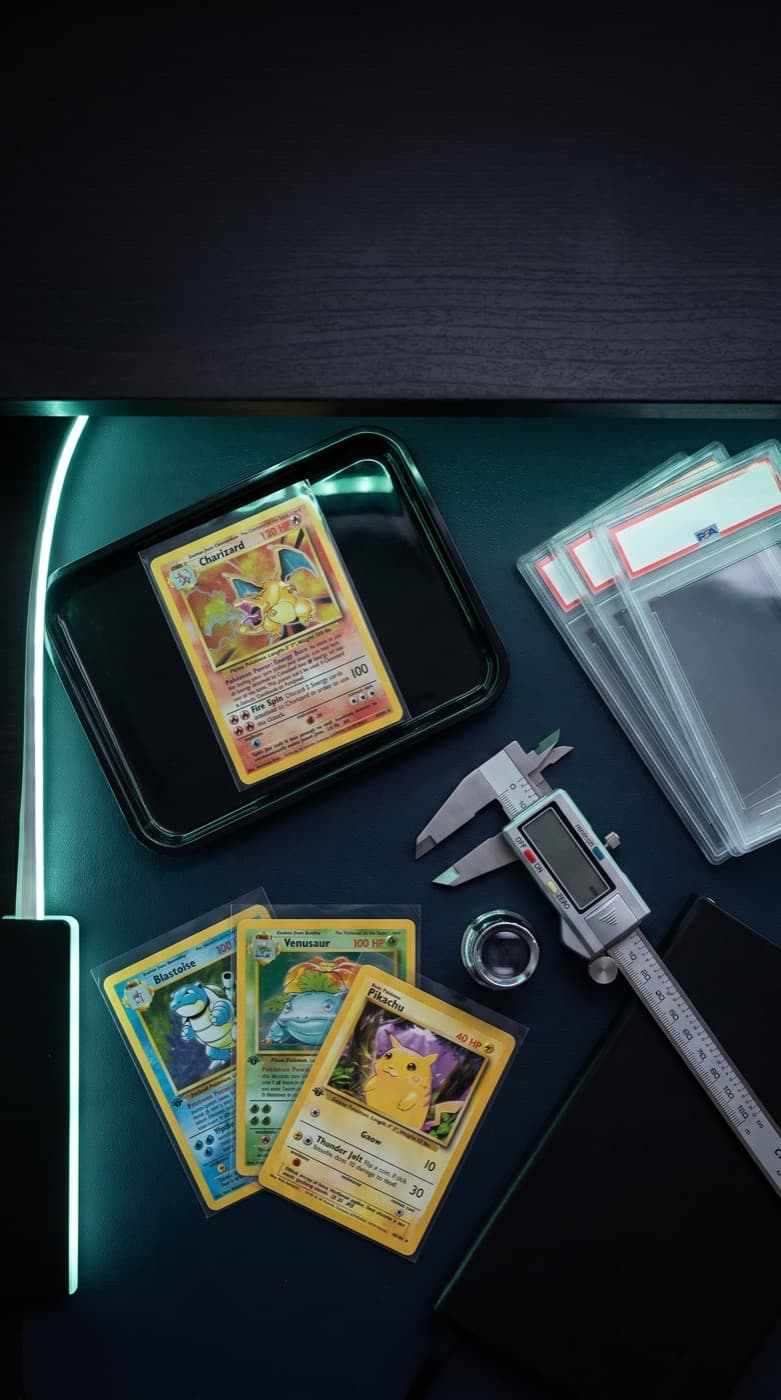
Cash, your phone with a full battery, a loupe, a small light and supplies to protect what you buy. Everything else depends on whether you’re there to buy, sell or trade.
- Cash in small bills. Many dealers take card or app payments, but cash is faster, and some dealers will shade the price for it.
- Your phone and a battery pack. You’ll be checking sold prices and cert numbers all day, and a dead phone means buying blind.
- A jeweler’s loupe. Corners, edges and print dots are hard to judge by eye under hall lighting.
- A small flashlight. Raking light shows scratches and dents that hall lighting hides.
- Penny sleeves, top loaders and team bags. Not every dealer hands them out, and a raw card in your pocket doesn’t stay near mint for long.
- A want list with your top price for each card. Written at home, when you’re calm.
- If you’re selling or trading: your cards sorted in a binder or box, each with the price you want and the lowest you’ll take.
How do dealers price cards at a card show?
Dealers sell at or near the recent market price and buy below it, because the gap is their margin. The sticker is where the talk starts, not where it ends.
On the selling side, most dealers check the same numbers you do: TCGplayer’s Market Price for raw modern cards, recent eBay sales for slabs and vintage. As one Phoenix dealer told Cronkite News, “I’m usually going to price based on what was last sold.” On the buying side there’s no published rate, but collectors and hobby writers put cash offers at roughly 60–80% of market, with trade credit worth more than cash. Treat those as anecdotal ranges, not rules.
- Dealer’s sticker priceShare of market About 100%, sometimes more on hot cardsAbout $200
- Dealer cash offerShare of market Roughly 60–80%$120–$160
- Dealer trade creditShare of market Usually above the cash offerMore than $120–$160
- Sell it yourself on eBayMost money, slowestShare of market 13.25% + $0.40 fee, then postageAbout $173 before postage
| Route | Share of market | On a $200 card |
|---|---|---|
| Dealer’s sticker price | About 100%, sometimes more on hot cards | About $200 |
| Dealer cash offer | Roughly 60–80% | $120–$160 |
| Dealer trade credit | Usually above the cash offer | More than $120–$160 |
| Sell it yourself on eBayMost money, slowest | 13.25% + $0.40 fee, then postage | About $173 before postage |
Selling to a dealer costs you some of the market price in exchange for money today, with no listing, shipping or returns. For a stack of $10 cards that’s often worth it. For one $500 card it usually isn’t. Our guide to where to sell Pokémon cards compares every route on fees.
How do you check a card at the table before you buy it?
Ask before you handle it, then spend a minute on the back edges, the corners, the surface under your light and the centering. For a slab, look up the cert number and compare the card inside with the record.
Checking a raw card
- Ask first. Most dealers will let you take a card out of its top loader. Hold it by the edges, over the table.
- Flip it over. The dark blue back shows whitening along the edges and corners that the front hides. A few white specks are the usual reason a near mint card isn’t a 10.
- Loupe the corners. All four, front and back. Rounding, fraying or a lifted layer drops the grade fast.
- Rake your light across the surface. Hold the light low and tilt the card. Scratches on the holo, print lines and dents show up only at an angle.
- Compare the borders. Left against right, top against bottom. A border you can see is thicker on one side is usually past what a 9 allows.
Our guide to Pokémon card condition shows what near mint, lightly played and the grades in between look like, so you know what you’re paying for when a dealer writes NM on the sleeve.
Is it real?
Fakes turn up at shows too, especially gold cards, modern chase cards and vintage holos. Check the font of the attack text, the set symbol, card number and copyright line, and how the foil moves. A fake often feels too glossy or too thin. Our guide to how to tell if a Pokémon card is fake goes through every tell.
Checking a slab
Type the cert number into the grader’s lookup, or scan a PSA label with the PSA app, and check the card and grade match. Where the record has PSA’s own photos, compare the corners and centering with the card in the case. A match proves the number is real, not that this case is the one PSA sealed, so look at the label edges and case seams too.
That last check matters. In January 2026 a federal jury in New York convicted Anthony Curcio of wire fraud for selling sports and Pokémon cards in cases with forged PSA labels, grades and cert numbers, a scheme prosecutors put at more than $2 million. He sold them online, at auctions and at card shows. Our PSA cert lookup guide covers the slab checks a lookup can’t do.
Should you pay extra for a raw card that “looks like a 10”?
Only if you’ve checked it as hard as a grader would and the price still leaves room for it to come back a 9. A dealer who prices a raw card between raw and PSA 10 is selling you the chance of a 10, and you’re the one paying the grading fee and the wait.
On modern chase cards a PSA 9 often sells for about the raw price, so a raw card priced halfway to the 10 loses money every time it misses. Look up sold prices for raw, PSA 9 and PSA 10, then be honest about the odds. The PSA 9 vs PSA 10 guide explains what usually separates them, and is it worth grading Pokémon cards has the break-even sum.
Should you sell to a dealer or trade at a card show?
Trade when the dealer has a card you actually want, because trade credit usually beats their cash offer. Sell for cash when you just want the money today and the cards are cheap enough that the gap to selling online isn’t worth the work.
- Ask both numbers. “What would you pay cash, and what would you give in trade?” The gap tells you how much the dealer wants your card.
- Check the comps on both sides. A strong trade credit means little if the dealer counts their own cards above market.
- Trade with collectors at full value. Collectors trading binder to binder usually count each other’s cards at 100% of market.
- Sell bulk and low-value cards to dealers. Listing a $5 card online costs more time than the dealer’s discount.
- Keep big cards for the best buyer. For a single valuable card, show it to several dealers, or sell it online or at auction where more buyers see it.
How do you haggle at a card show?
Be polite, be quick and make a fair offer. Hobby guides suggest opening around 80–90% of recent sold prices on a single card, and most dealers expect some back and forth.
- Say hello before you ask a price. Pointing at a card and saying “how much?” starts the deal badly.
- Don’t interrupt another deal. Wait until the dealer is free, and don’t pick up cards someone else is looking at.
- Make a real offer. Something you’d actually pay, based on sold prices, not a lowball to see what sticks.
- Bundle. Pulling three or four cards and asking for a price on the stack usually gets a better rate than haggling each one.
- Show comps only when asked, and calmly. Pushing your phone across the table rarely helps; dealers know the market. Use the comps to set your own limit.
- Walk away politely. If you can’t meet, thank them and move on. You may want to buy from that table later, and they remember.
Can you get cards graded at a card show?
Yes, at shows where a grader has a booth. Usually you drop cards off and they’re graded back at the company’s office and shipped to you. At a few big shows, PSA and CGC also grade on site and hand slabs back before the show ends, for a higher fee.
- Bulk (25-card minimum)Max $500 · By the end of the show$40
- EconomyMax $1,000 · End of the next show day$45
- StandardMax $3,000 · End of the day$90
- ExpressMax $10,000 · End of the day$160
- WalkThroughFastestMax $100,000 · About three hours$400
| CGC tier | Fee per card | Max value | Back in your hands |
|---|---|---|---|
| Bulk (25-card minimum) | $40 | $500 | By the end of the show |
| Economy | $45 | $1,000 | End of the next show day |
| Standard | $90 | $3,000 | End of the day |
| Express | $160 | $10,000 | End of the day |
| WalkThroughFastest | $400 | $100,000 | About three hours |
PSA offers on-site grading only at select shows, and space runs out. For the Toronto Sport Card Expo in November 2026, PSA’s event page caps on-site submissions at 20 cards a customer, subject to tier availability. Third-party coverage of The National 2026 reported PSA On-Site Express at $229 a card for cards worth up to $2,500. CGC also takes plain drop-offs at shows such as Collect-A-Con; you fill in its online form, choose Mail-In or Show Drop-Off, and bring both copies of the packing slip.
On-site grading suits a card you want to sell at the same show. For a binder of modern hits, the regular tiers cost far less. Our guide to where to get Pokémon cards graded compares show drop-offs with GameStop, mailing PSA and group submitters.
Are Pokémon card shows worth going to?
Yes, if you go with a list and a budget. You can see cards in hand, trade, sell a pile of cards in an afternoon and, at bigger shows, get cards graded. The people who come home unhappy usually skipped the checks: they paid a 10 price for a 9, trusted a slab without looking it up, or took the first cash offer on a good card.
Questions people ask
Do card show vendors take trades?
Most do, and many prefer trades because they make a margin on both cards. Ask for the cash offer and the trade credit, since the trade number is usually higher.
How much do dealers pay for Pokémon cards at a show?
There’s no set rate. By collectors’ and hobby writers’ accounts, cash offers often land around 60–80% of the recent market price, less for cards the dealer doesn’t need and more for cards they can sell quickly.
Are cards cheaper at card shows than online?
Not usually on the sticker, since dealers price from the same sold data as everyone else. You save on shipping and can negotiate, especially on bundles and late on the last day.
Do card shows take credit cards?
Many dealers take cards or payment apps, but not all, and some give a better price for cash. Bring enough cash for the cards you most want.
Can I sell my Pokémon cards at a card show without a table?
Yes. Walk the floor and ask dealers who are buying. Bring your cards sorted and protected, know the market price of each, and show a valuable card to more than one dealer before you accept.
Is it safe to buy graded cards at a card show?
Mostly, if you check. Look up the cert number on the spot, compare the card inside with the grader’s photos where they exist, and inspect the label and case. Forged slabs have been sold at shows.
Sources
- Trading Card Database, Card Shows calendar (found in Google US results for “pokemon card shows” via DataForSEO, 25 October 2026)
- Collect-A-Con, home page: tour stops, 900+ vendor tables, Pokémon featured (checked 25 October 2026)
- Beckett, Event calendar (checked 25 October 2026)
- The Copper Courier / Cronkite News, Pokémon at the Arizona State Card Show, April 9, 2025: table costs and dealer pricing (checked 25 October 2026)
- Card Codex, How to negotiate good deals at card shows, October 30, 2025: dealer cash offers and opening offers; secondary source (checked 25 October 2026)
- Card Codex, The Pokémon card trade 80% value explained, August 27, 2025: shop and collector trade rates; secondary source (checked 25 October 2026)
- eBay, Selling fees: Collectible Card Games final value fee (checked 25 October 2026)
- PayPal, Does PayPal cover my purchase if there’s a problem? (Friends and Family not eligible) (checked 25 October 2026)
- PSA: Card Scanner & Grading, App Store listing: scan PSA labels to verify (checked 25 October 2026)
- PSA, Cert Verification (checked 25 October 2026)
- US Attorney’s Office SDNY, Perpetrator of nationwide sports and Pokémon trading card fraud convicted, January 2026 (checked 25 October 2026)
- CGC, On-site grading with CGC and JSA at The National 2026: tiers, fees, pick-up times (checked 25 October 2026)
- CGC, Show drop-off at Collect-A-Con Atlanta 2026: how to submit at a show (checked 25 October 2026)
- PSA, On-site grading and specials at the Toronto Sport Card Expo: 20-card limit (checked 25 October 2026)
- Just Collect, PSA on-site grading pricing at the 2026 National, July 3, 2026; secondary source (checked 25 October 2026)
Buddy is independent and isn’t affiliated with PSA, CGC, Beckett, TAG, SGC or The Pokémon Company. Fees and prices change; we re-check them when we update a guide.