On this page
- PSA tiers, limits and timing at a glance
- Step 1: Identify and inspect the card before you order
- Step 2: Choose a submission route and create the order
- Step 3: Pack, photograph and ship the card
- Step 4: What happens during grading and how long it takes
- Step 5: What you get back and how to check it
- What "PSA graded" means
- The PSA grading scale, grade by grade
- Is grading worth the fee? A net-proceeds check
- When not to submit
- Frequently asked questions
- Sources
PSA grading runs in five stages: you identify and inspect the card, create an order online, ship the card, wait through a queue that PSA estimates in business days, and receive a slabbed card with a 1-to-10 grade. On the November 2, 2026 check by Polkastarter, PSA listed three open price tiers: Value at $39.99 per card with an estimated 90 to 100 business days, Standard at $59.99 with 70 to 80 business days, and Priority at $79.99 with 50 to 60 business days1. Those numbers change faster than most grading guides are updated, so treat them as a snapshot and confirm them in your account before you pay.
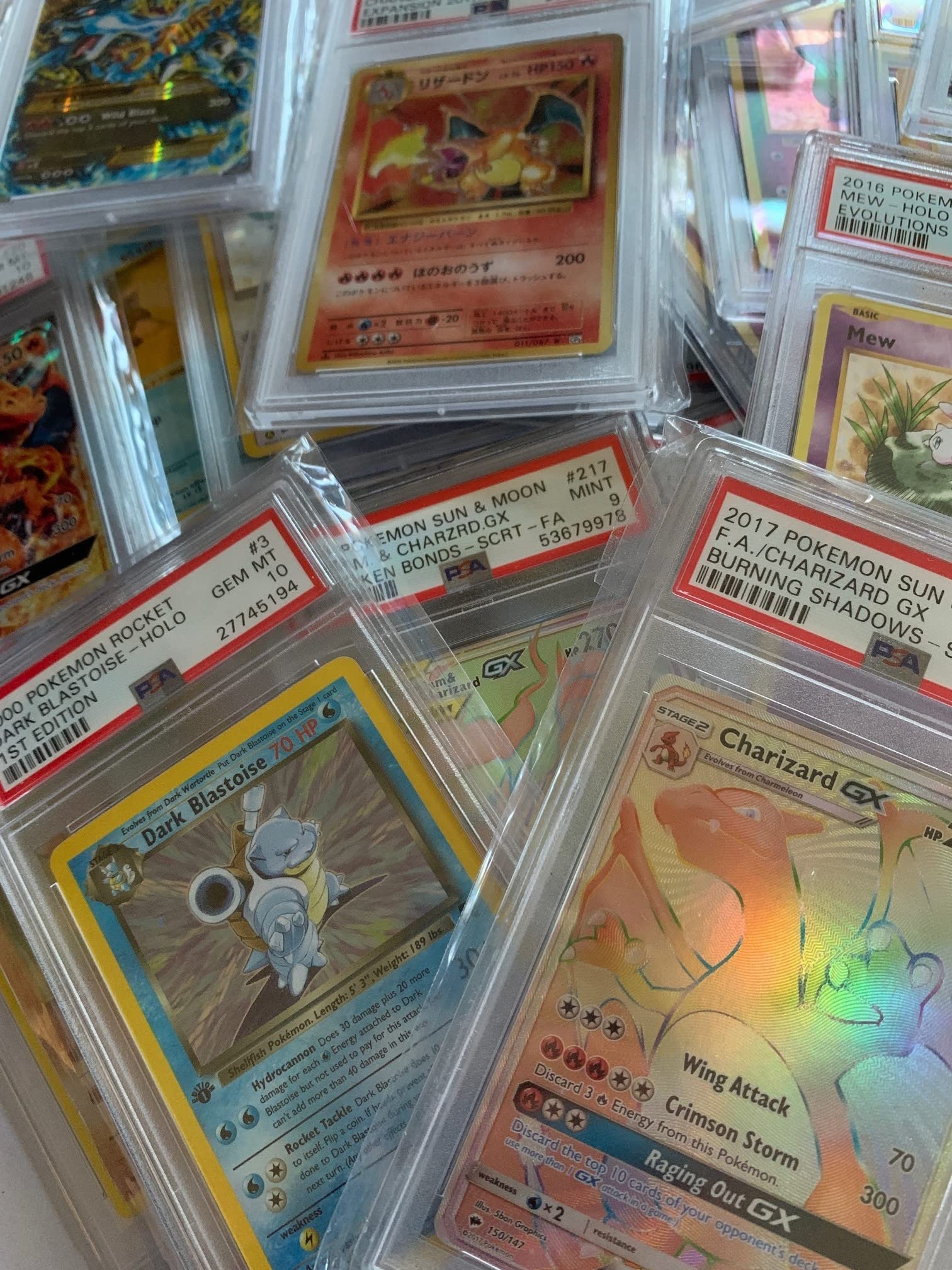
This guide walks through the whole path in order, then explains what a PSA grade means, what a PSA 7 looks like, what "ex mint" refers to, and how the scale reads for other card types. The examples lean on Pokémon, but PSA's process is the same for any trading card.
PSA tiers, limits and timing at a glance
The fee tier you pick sets your price, the maximum insured value you can declare, and the estimated wait. Polkastarter read PSA's trading card grading page on November 2, 2026 and recorded these US prices1.
| Tier | Price per card | Maximum insured value | Estimated grading time |
|---|---|---|---|
| Value | $39.99 | $500 | 90 to 100 business days |
| Standard | $59.99 | $1,000 | 70 to 80 business days |
| Priority | $79.99 | $1,500 | 50 to 60 business days |
Two cautions apply to this table. First, the Value tier has been unstable. PSA reopened it on October 29 after pausing it on June 2, and PSA says new Value orders join the queue behind orders already at PSA. Polkastarter noted that PSA's page still showed a paused notice above the Value price on November 2, so check whether the tier is actually available when you build the order1.
Second, the turnaround is an estimate, not a delivery promise. Shipping and intake happen outside the grading window, so the real gap between mailing a card and getting it back is longer than the figure in the table1. For a wider cost comparison across companies, the PSA, BGS, CGC and TAG price breakdown covers what each service charges.
Step 1: Identify and inspect the card before you order
Start by recording exactly what you hold, because the order form asks you to describe the card and a wrong description causes problems later. Polkastarter's guide says to record the set, number, language, edition and any recognized variant, then compare the card with reliable reference images1. For Pokémon this matters more than for most games, because the same character appears across many printings with very different values.
Next, look at the card under clear light. Check four things: corners, edges, surface and centering. PSA's grading standards assess more than centering, and meeting a centering tolerance alone does not promise a Gem Mint result1. MoneyMade's guide lists the same four factors, centering, corners, edges and surface quality, as the ones that influence the grade2.
A card can leave a pack already damaged. Polkastarter points out that a print line or edge defect can exist on a fresh pull, and that "pack-fresh" describes when the card was opened, not the grade it will receive1. Do not clean, press or alter the card to try to improve the result.
Where Buddy fits before you pay
This is the stage where a pre-check saves money, because every card you ship costs a fee whatever the grade. You photograph the card in Buddy and it estimates the odds of each grade from PSA, CGC, Beckett, TAG and SGC. It also measures centering against grader standards for a potential 10, checks lettering, numbers, print and foil for authenticity, and shows pricing based on real sales from platforms like eBay and TCGplayer. You get an estimate, not an official grade, so you can decide which cards are worth sending before you build the order. If centering is the question, the PSA 10 centering requirements for Pokémon piece explains the tolerances in detail.
Step 2: Choose a submission route and create the order
PSA offers three ways to get cards to it, and the online route is the common one. MoneyMade's guide lists them: high-value items can be dropped off at PSA's Woodbridge, NJ office on a case-by-case basis, you can submit at a PSA-attended trade show, or you can use PSA's Online Submission Center, which MoneyMade calls the most popular option2.
For most collectors that means the online route. You create the order using PSA's current submission process, check the card description and the chosen service, then follow the company's current packing instructions1. If you are still deciding whether PSA is the right company at all, the Beckett vs PSA comparison lays out how the two differ before you commit to an order.
Declare the value honestly
Pick the tier that matches the card's real value, not the cheapest tier. Polkastarter advises using the service's value guidance honestly rather than selecting a cheaper tier by understating the card, and says to review what the company may do if the value falls outside the selected level1. The maximum insured value in the table above is the practical limit: a card worth more than $500 does not belong in the Value tier.
Do you need a paid membership?
No. According to PSA's FAQ, as reported by Polkastarter, paid Collectors Club membership is not required for an ordinary submission. Optional membership and the availability of member services are a separate question, so recheck the form and service page before you pay1.
Step 3: Pack, photograph and ship the card
Before the card leaves your hands, document it. Polkastarter recommends photographing the card before dispatch and keeping the order record and shipment tracking together1. That record is what you compare against when the card returns.
Keep three practical steps in mind when submitting your cards:
- Follow PSA's current packing instructions. They are published by PSA and can change, so read them at the time you ship rather than relying on an older guide1.
- Check insurance separately. Shipping insurance and the grading service's coverage terms are two different things and each needs its own check1.
- Keep tracking together with the order. If a package goes missing or a dispute arises, the paper trail is your evidence.
Submitting in person is the exception. MoneyMade notes that the Woodbridge, NJ drop-off applies to high-value items on a case-by-case basis, so it is not a general walk-in service for ordinary cards2.
Step 4: What happens during grading and how long it takes
Once PSA receives the card, it enters the queue for your tier. Polkastarter's snapshot shows that the queue is long: 50 to 60 business days at Priority, 70 to 80 at Standard and 90 to 100 at Value1. The guide describes PSA grading as combining authentication and a condition assessment1.
Turnaround is an estimate
When PSA says 70 to 80 business days, that is the estimated grading period only. Polkastarter tells readers to allow for shipping and intake outside that estimate, and not to promise a buyer a return date based only on the advertised grading period1. Business days also exclude weekends and holidays, so 50 business days is about ten calendar weeks before shipping is added, and 100 business days is closer to twenty weeks.
The Value tier's history shows why plans slip. It was paused on June 2 and reopened on October 29, and PSA says new Value orders queue behind those already at the company1. If you want to track whether the queue is moving, the PSA grading app options article covers tools collectors use around a submission.
Step 5: What you get back and how to check it
The card comes back graded and encapsulated with a label. When it arrives, match the label and the certification record against your original photographs and submission details1. This confirms that the card in the holder is the card you sent.
Treat the number on the label as an opinion. Polkastarter describes a numerical grade as a professional opinion about the submitted object, not a promise of a particular sale price1. The same page states plainly that PSA grading does not guarantee a higher resale result1.
MoneyMade adds that grade is only one part of value. It says rarity and popularity matter as much, and that a common card with a high share of PSA 10s may be worth little simply because plenty of perfect copies exist2. A low-population rare card can be worth far more even in a lower grade.
What "PSA graded" means
"PSA graded" means the card was authenticated by Professional Sports Authenticator, assigned a condition grade on a 1-to-10 scale, and sealed in a tamper-evident holder with a label. PSA assigns grades on that 1-to-10 scale, and each level indicates a specific quality2. Polkastarter frames the service as two jobs in one: authentication and a condition assessment1.
Scale matters for trust. MoneyMade reports that PSA has authenticated and graded over 40 million cards worth over $1 billion, and calls it a widely respected universal grading standard. That is MoneyMade's characterization, and the site discloses affiliate relationships with platforms it covers, so read the praise as a vendor-adjacent claim rather than neutral measurement2. MoneyMade also notes that Beckett and SGC are viable alternatives, though PSA is the first choice for many collectors2.
If you want to see how the major companies compare side by side, the PSA vs Beckett vs CGC comparison is the next read.
The PSA grading scale, grade by grade
PSA grades from 10 down to 1, and the top grades are separated by small flaws. MoneyMade's breakdown gives these grade descriptions as a useful scale guide2.
| Grade | Name | What MoneyMade says it indicates |
|---|---|---|
| 10 | Gem Mint | Virtually perfect: four sharp corners, flawless edges, pristine centering |
| 9 | Mint | Tiny imperfections, such as a slight surface flaw, minor print blemish or slightly off-center |
| 8 | Near Mint-Mint | Good quality with minor issues such as slight centering problems, subtle edge wear or slight surface wear |
| 7 | Near Mint | Some visible flaws, such as minor corner wear or poor centering, but generally good appeal |
| 6 to 3 | Excellent-Mint to Very Good | More noticeable wear: soft corners, surface scratches or edge issues |
| 2 to 1 | Good to Poor | Serious damage such as creases, discoloration or rounded corners |
PSA also publishes a Photograde tool that shows the visual differences between each grade, which MoneyMade says helps you judge the condition of your own cards2. For Pokémon collectors who want to know where their cards might land, comparing a card against the Photograde images is the free first check.
What does a PSA 7 look like?
A PSA 7 is a Near Mint card with visible but modest flaws. MoneyMade describes it as a card that can show minor corner wear or poor centering that affects the overall balance, while still being a great card to own, especially among vintage items2. It sits one step below the NM-MT 8, where issues are described as slight centering problems, subtle edge wear or slight surface wear.
In practice, you would see a PSA 7 as a card that looks clean at arm's length but shows its flaws on close inspection: a corner that has begun to soften, a border that is visibly uneven, or light wear along an edge. It is not damaged, but it is not near-perfect either. MoneyMade says that for vintage cards the grade retains a generally good aesthetic appeal2.
What is ex mint PSA?
"Ex mint" is PSA's EX-MT 6 grade, Excellent-Mint, and it sits below Near Mint. MoneyMade groups it in a band running from EX-MT 6 down to VG 3, where cards show more noticeable wear, including soft corners, surface scratches or edge issues2. That band can still be highly valued, particularly for vintage cards.
The practical point is that a 6 is a clearly circulated card, not a pack-fresh one. If your modern Pokémon pull looks like a 6, grading at $39.99 or more is unlikely to make sense on condition alone, because the grade rarely adds value for a common modern card. Rarity and scarcity can change that for older or low-population cards, but the grade is rarely the reason.
What are the different grades for baseball cards?
The grades are the same for baseball cards as for Pokémon: PSA uses one 1-to-10 scale across trading cards. MoneyMade's examples are baseball-heavy, including a Michael Jordan 1986 Fleer rookie in PSA 10 that it says can sell for around $700,000, and it cites a 1909-11 T206 Honus Wagner PSA 1 that sold for millions despite serious damage2. Those examples show two things: a top grade on a key card commands a premium, and scarcity can make even a low grade valuable.
The Jordan card is a basketball example, but the logic carries over to any sport or game. The scale does not change; what changes is how the market prices each grade for a given card.
Is grading worth the fee? A net-proceeds check
Grading pays only when the likely graded price beats the raw price after all costs. Polkastarter works a hypothetical to show the arithmetic. Suppose a raw card could sell for $80, a PSA 10 sells for $220, a PSA 9 sells for $95, selling fees are 13%, and $25 covers all non-grading submission costs. At the Standard fee of $59.99, the total submission cost is $84.991.
| Outcome | Calculation | Net proceeds |
|---|---|---|
| Sell raw | $80 minus 13% | $69.60 |
| PSA 10 at Standard | $220 minus 13%, then minus $84.99 | $106.41 |
| PSA 9 at Standard | $95 minus 13%, then minus $84.99 | negative $2.34 |
Dropping to the Value fee of $39.99 makes the total $64.99, which leaves $126.41 in the PSA 10 case and $17.66 in the PSA 9 case. Even then, the PSA 9 result is $51.94 below the raw sale, and Value adds about 20 business days to PSA's Standard estimate1. Polkastarter labels these as net proceeds after stated costs, not profit after buying the card, and says the prices are illustrative, not market quotes.
The lesson is sensitivity. If only a PSA 10 makes the decision work, you are betting on a grade nobody can guarantee1. Run the same sum with your real costs and genuinely comparable sales.
Use Buddy to weight the odds
The arithmetic above needs a grade assumption, and that is the weak point. In Buddy you photograph the card and it estimates the odds of each grade, so you can see whether a PSA 10 is realistic or a stretch before you commit to a fee. It pairs that with pricing from real sales on platforms like eBay and TCGplayer, so you can compare raw and graded values for your own card. The card grading services ranking can help if the odds point you toward a different company.
When not to submit
Keep a card raw when the service cost outweighs its likely use to you, when its identity is unresolved, or when you want it for a binder. Polkastarter says a sentimental reason for grading is valid but should not be disguised as a financial certainty1.
A few cases clearly fall on the raw side:
- Common cards with many PSA 10s. MoneyMade notes that a common card with a high share of PSA 10 grades may not be worth much because perfect copies are plentiful2.
- Cards with visible flaws. Corner wear, edge defects and print lines are the issues that hold grades down1.
- Cards you cannot identify. If the set, number or variant is uncertain, resolve that first.
On the other side, MoneyMade points to rarity and low population as drivers of value, citing the Mickey Mantle #311 as a card that can rise in value even without a perfect grade2. The fee decision depends on the card, not on a rule of thumb.
Frequently asked questions
What does "PSA graded" mean?
It means PSA authenticated the card, assigned it a grade from 1 to 10 and sealed it in a labelled holder. PSA describes the service as combining authentication with a condition assessment1. The grade reflects centering, corners, edges and surface quality2.
What does a PSA 7 look like?
A PSA 7 is Near Mint with visible flaws, such as minor corner wear or centering that hurts the card's balance. MoneyMade says it is still a great card to own, especially among vintage items, and that it keeps a generally good aesthetic appeal2.
What is ex mint PSA?
Ex mint is PSA's EX-MT 6 grade, Excellent-Mint. MoneyMade places it in the band from EX-MT 6 to VG 3, where cards show more noticeable wear such as soft corners, surface scratches or edge issues, though they can still be highly valued when vintage2.
What are the different grades for baseball cards?
Baseball cards use the same PSA 1-to-10 scale as Pokémon and other trading cards, from Poor 1 up to Gem Mint 102. MoneyMade's examples include a 1986 Fleer Michael Jordan in PSA 10 selling around $700,000 and a PSA 1 Honus Wagner T206 selling for millions2.
How long does PSA grading take?
PSA's estimates on the November 2, 2026 check were 50 to 60 business days for Priority, 70 to 80 for Standard and 90 to 100 for Value, excluding shipping and intake1. Treat these as estimates, not a delivery date, and recheck the tier before you pay.
Sources
Buddy is independent and isn’t affiliated with PSA, CGC, Beckett, TAG, SGC or The Pokémon Company. Fees and prices change; check the sources for the latest.