On this page
The short answer
A Pokémon card error is worth extra only when it’s a recognized, repeatable printing mistake that collectors chase, like the Jungle No Symbol holos. Most misprints aren’t: miscuts, crimps, ink spots and print lines are flaws, not prizes, and on a modern card they usually cost you the grade instead of adding value.
What counts as an error on a Pokémon card?
An error is a card printed differently from how it was meant to be, and collectors split them into three kinds: design errors (wrong text, symbol or art on the plate), repeating ink errors (the same blob or streak on every card from one sheet position), and one-off accidents (a bad cut, a pack crimp, an upside-down back). Only the first two are “collectible” in the usual sense, because many identical copies exist and people can tell them apart.
Bulbapedia’s error list draws the line that matters for value. Errors that were corrected partway through a print run left a small number of copies, which is what makes them scarce. Errors that were never corrected were mass-produced, so every copy has them, and Bulbapedia calls those notable but “not rare or desirable to collectors.”
- Corrected design errorCan payExample Base Set Blastoise missing “Stage”, Shadowless Ninetales missing its 80 damageUsually Worth a premium if collectors chase it
- Repeating ink errorExample Jungle Butterfree “d” Edition stamp, Base Set Black Dot CharizardUsually Small premium; needs to match known copies
- Uncorrected design errorExample Jungle Seaking told to go “on the Stage 1 card”, Team Rocket Dark Dragonite #5 with no holoUsually No premium: every copy has it
- One-off production accidentExample Miscut, crimp, inverted back, wrong backUsually Depends on how dramatic, and on the grader
- Intentional variantExample Red cheeks Pikachu, Shadowless, 1st Edition Ivy PikachuUsually Not an error, though often sold as one
| Kind | Example | Usually |
|---|---|---|
| Corrected design errorCan pay | Base Set Blastoise missing “Stage”, Shadowless Ninetales missing its 80 damage | Worth a premium if collectors chase it |
| Repeating ink error | Jungle Butterfree “d” Edition stamp, Base Set Black Dot Charizard | Small premium; needs to match known copies |
| Uncorrected design error | Jungle Seaking told to go “on the Stage 1 card”, Team Rocket Dark Dragonite #5 with no holo | No premium: every copy has it |
| One-off production accident | Miscut, crimp, inverted back, wrong back | Depends on how dramatic, and on the grader |
| Intentional variant | Red cheeks Pikachu, Shadowless, 1st Edition Ivy Pikachu | Not an error, though often sold as one |
That last row trips up a lot of sellers. Bulbapedia files the red cheeks Pikachu as a design change, not a mistake: the cheeks were recolored red without the illustrator Mitsuhiro Arita’s approval and later switched back to his yellow. Shadowless Base Set cards aren’t errors either; they’re an early print run, which our guide to 1st Edition and Shadowless cards explains.
Which Pokémon card errors are worth money?
The ones with a name, a page in PSA’s error guide and a steady stream of buyers, and even then the premium is smaller than most listings suggest. Put recent sales of the error next to the same card without it and the gap is often modest, sometimes zero.
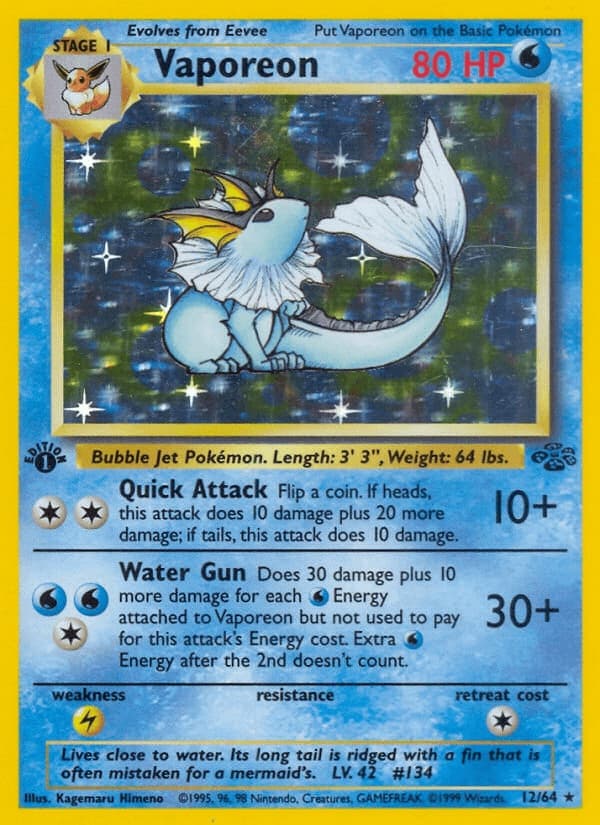
- Vaporeon, Jungle unlimited holo, 12/64PremiumNo Symbol: the flower set symbol is missing · Without PSA 8: $144, 24 Oct 2026PSA 8: $275, 24 Oct 2026
- Blastoise, Base Set unlimited holo, 2/102“Stage” left out of “Put Blastoise on the Stage 1 card” · Without PSA 8: $340 to $412, 23–24 Oct 2026PSA 8: $385, 23 Oct 2026
- Pikachu, Base Set Shadowless, 58/102Red cheeks (a variant, not an error) · Without Yellow cheeks PSA 8: $76 to $210, Sep–Oct 2026PSA 8: $167 to $200, 14–21 Oct 2026
- Pikachu, Base Set Shadowless, 58/102PremiumGhost Stamp: only a faint outline of the 1st Edition stamp · Without Yellow cheeks PSA 8: $76 to $210, Sep–Oct 2026CGC 8: $900, May 2022
- Ninetales, Base Set Shadowless holo, 12/102No Damage: the 80 is missing from Fire Blast · Without PSA 9: $699, 22 Oct 2026Too few public sales to quote
| Card | Error | Recent sales | Without the error |
|---|---|---|---|
| Vaporeon, Jungle unlimited holo, 12/64Premium | No Symbol: the flower set symbol is missing | PSA 8: $275, 24 Oct 2026 | PSA 8: $144, 24 Oct 2026 |
| Blastoise, Base Set unlimited holo, 2/102 | “Stage” left out of “Put Blastoise on the Stage 1 card” | PSA 8: $385, 23 Oct 2026 | PSA 8: $340 to $412, 23–24 Oct 2026 |
| Pikachu, Base Set Shadowless, 58/102 | Red cheeks (a variant, not an error) | PSA 8: $167 to $200, 14–21 Oct 2026 | Yellow cheeks PSA 8: $76 to $210, Sep–Oct 2026 |
| Pikachu, Base Set Shadowless, 58/102Premium | Ghost Stamp: only a faint outline of the 1st Edition stamp | CGC 8: $900, May 2022 | Yellow cheeks PSA 8: $76 to $210, Sep–Oct 2026 |
| Ninetales, Base Set Shadowless holo, 12/102 | No Damage: the 80 is missing from Fire Blast | Too few public sales to quote | PSA 9: $699, 22 Oct 2026 |
Two lessons sit in that table. The Jungle No Symbol Vaporeon sold for nearly twice a normal unlimited copy in the same grade on the same day, because No Symbol holos are a named, popular set of 16 that people collect as a run. The Stage error Blastoise is on PSA’s official list and still sold inside the range of ordinary PSA 8s that week. Recognition gets an error on the label; it doesn’t guarantee anyone pays more for it.
Rarity alone doesn’t help either. Bulbapedia counts “undoubtedly” over 100 Jungle 1st Edition Butterfree with the “d” Edition stamp, while true one-offs, like the ten known German Base Set cards printed on Magic: The Gathering backs, are so rare they rarely trade in public at all. For cards that sell for serious money with or without a misprint, see our list of the rarest Pokémon cards.
Are miscut, crimped or ink line Pokémon cards worth anything?
Usually not much, and the two big graders treat them differently. CGC grades many factory accidents as errors and names them on the label; PSA mostly treats them as flaws that hold the grade down.
- MiscutWhat it is The cut lands off the card, showing part of the next card · PSA MC qualifier, or no grade under its N8 Miscut codeGraded as Miscut, Minor Miscut or Major Miscut
- CrimpWhat it is The pack’s heat seal pressed into the card · PSA Not on its Pokémon error listGraded as Partial Crimp, Crimped or Crimped & Cut
- Ink spotWhat it is A dot or blob of stray ink · PSA Named only if the same spot shows on several documented copiesRecognized as Additional Ink or Printer Hickey
- Holo bleedWhat it is Foil showing through where ink should be · PSA Not on its Pokémon error listNot recognized
- Print lineWhat it is A faint line across the surface from the press · PSA Counts as a print defect: PD qualifier or a lower gradeNot one of its error types
| Flaw | What it is | PSA | CGC |
|---|---|---|---|
| Miscut | The cut lands off the card, showing part of the next card | MC qualifier, or no grade under its N8 Miscut code | Graded as Miscut, Minor Miscut or Major Miscut |
| Crimp | The pack’s heat seal pressed into the card | Not on its Pokémon error list | Graded as Partial Crimp, Crimped or Crimped & Cut |
| Ink spot | A dot or blob of stray ink | Named only if the same spot shows on several documented copies | Recognized as Additional Ink or Printer Hickey |
| Holo bleed | Foil showing through where ink should be | Not on its Pokémon error list | Not recognized |
| Print line | A faint line across the surface from the press | Counts as a print defect: PD qualifier or a lower grade | Not one of its error types |
A dramatic miscut, with half of another card showing, has buyers among error collectors, and a CGC Major Miscut label makes it easy to sell. A slightly off cut is just poor centering, and nobody pays extra for that. Crimps are the same story: a full, clean crimp on a vintage rare is a curiosity; a partial one on a modern common is a damaged card.
What about modern Pokémon card errors?
Modern sets print in huge numbers, so most modern “errors” are one-off factory flaws rather than chase cards. PSA’s guide does name a few modern types, such as the Missing Texture Error on full art cards, but only when the texture is missing from the whole card. It also warns that modern inverted backs are commonly miscut, which affects how they grade.
Does an error lower a Pokémon card’s grade?
A design error doesn’t; a physical flaw does. Graders judge the card in front of them, so a missing word in the text costs nothing, but a print line, ink blob, crimp or bad cut is a defect on the surface or edge and is graded like one.
PSA’s definition of a 10 leaves little room: a Gem Mint card may get “an allowance” for “a slight printing imperfection, if it doesn’t impair the overall appeal of the card.” Anything more and PSA either adds its PD (print defect) qualifier or gives a number low enough to cover the flaw. That’s why a modern card with a visible print line can easily land at a 9 or lower. On a modern card the 10 is most of the value, so the line costs money rather than adding any. The PSA grading scale has the full wording for each grade.
The same goes for error cards you hope to sell graded. A Jungle No Symbol holo still has to be centered and clean to hit a 9 or 10, and the premium follows the grade. Our guide to the PSA population report shows how to see how many copies of a named error PSA has graded at each level.
How does PSA label Pokémon error cards?
PSA puts an error on the label only when it’s in its Pokémon Error Guide, a list it adds to as it recognizes new varieties. If your card’s error isn’t listed, PSA asks you to submit a research request so its team can evaluate it.
- Both versions get recognized. For corrected errors PSA recognizes the error and the fix separately, from Fossil Zapdos’s uncorrected and corrected foil to the Blaine’s Charizard with a Fighting symbol instead of Fire.
- Ink errors must repeat. PSA attributes dot errors only when the dots appear in the same place and shape on multiple documented copies, such as the Black Dot Charizard and Red Heart Clefairy.
- Foil and texture errors are named outright. “Missing Foil Error” goes on the label when the holo is completely missing, and Missing Texture Error only when the texture is gone from the entire card.
- Miscuts are not errors at PSA. An atypical cut gets the MC qualifier, and a cut that’s badly wrong can come back ungraded under code N8, or be slabbed as Authentic at the grader’s discretion if you asked for that on the form.
CGC takes the opposite view of factory accidents: its error guide says it was the first grader to authenticate and grade major error cards, and its guide names error types from crimps and miscuts to wrong backs and missing print layers. If your card is a one-off production accident rather than a listed variety, CGC is usually where it gets recognized. Our comparison of the best grading company for Pokémon cards covers the rest of the trade-offs.
How do you know if a Pokémon card is a misprint?
Compare it against a genuine copy of the exact same printing, then check whether the difference is a known, repeating error. Most cards people think are misprints turn out to be wear, a different printing, or a fake.
- Identify the exact printing. Set, number, 1st Edition or not, Shadowless or not. A Shadowless card has no drop shadow on the art box, which is a print run, not an error.
- Compare it with an official scan. Put it next to the same card in the official Pokémon card database or Bulbapedia and look for what’s missing, moved or a different color.
- Check the error lists. Search PSA’s Pokémon Error Guide and Bulbapedia’s error cards page. A named, repeating error is what buyers pay for.
- Rule out damage and wear. Scratches, dents, whitening and stains happened after the card left the factory. They’re never errors, and they lower the value.
- Rule out a fake. Counterfeits often look “wrong” in ways that pass for a misprint. Check the card before you call it an error.
Are there fake Pokémon error cards?
Yes, and they follow the money. In June 2022 CGC published a counterfeit alert about fake Ghost Stamp Pikachus with the faint stamp outline added by a home printer, a month after a genuine CGC 8 had sold for $900 on eBay.
CGC’s tells for that fake work as a general checklist for any added-on error. On a real Ghost Stamp, the middle of the T in EDITION lines up with the bottom-left corner of the art box; the fake sits too far left. The genuine outline is crisp, while the fake is mottled with blurred edges and tiny black specks of home-printer ink around it. CGC also found the forged stamp behaves differently under infrared light.
If a listing calls a card an error, ask for clear photos of both sides and compare the lettering and stamp with a genuine copy before you pay error money for it.
Questions people ask
Are Pokémon card misprints worth anything?
A few are. Named, repeating errors that collectors chase, like the Jungle No Symbol holos, sell for more than normal copies. Most misprints, including off cuts, crimps, ink spots and print lines, add nothing and often lower the grade.
What is the rarest Pokémon card error?
One-off production mistakes are the rarest. Bulbapedia lists ten known German Base Set cards, including a 1st Edition Growlithe, printed with Magic: The Gathering backs, which were caught and pulled before corner rounding and packaging.
Is the red cheeks Pikachu an error?
No. Bulbapedia classes it as an intentional design change that was later reversed, found on 1st Edition and Shadowless Base Set prints. It’s often sold as an error, but it’s a variant.
Are Shadowless Pokémon cards errors?
No. Shadowless cards are an early Base Set print run without the drop shadow beside the art box. They were produced on purpose and are collected as their own printing.
Does PSA grade miscut Pokémon cards?
PSA gives an atypical cut the MC qualifier. A badly miscut card can come back ungraded under PSA’s N8 Miscut code, or be slabbed as Authentic if you request it. CGC, by contrast, grades miscuts and names them on the label.
Is a crimped Pokémon card worth more?
Rarely. A crimp is the pack’s seal pressed into the card. CGC labels crimped cards as errors, and some error collectors want full crimps on vintage cards, but most crimped cards sell as damaged.
Sources
- PSA, Pokémon Error Guide: recognized errors, corrected versions, dot error rule, Missing Foil and Missing Texture (checked 25 October 2026)
- PSA, Grading Standards: PSA 10 definition, MC, PD and OF qualifiers, N8 Miscut code, trimming (checked 25 October 2026)
- CGC Cards, Error Guide, updated August 18, 2025: crimps, miscuts, printer hickeys, holo bleeds (checked 25 October 2026)
- CGC Cards, Counterfeit Card Alert: “Ghost” Stamp Error Pikachu, June 7, 2022: how the error formed, CGC 8 sale, how to spot the fake (checked 25 October 2026)
- Bulbapedia, Error cards: corrected vs uncorrected errors, red cheeks Pikachu, Butterfree “d” Edition, Magic-back German cards; secondary source (checked 25 October 2026)
- Elite Fourum, Masters Guide for Pokémon WOTC Corrected Errors & Test Cards: Shadowless not an error (checked 25 October 2026)
- Sports Card Investor, Vaporeon 1999 Jungle #12/64 Unlimited Holo (No Symbol): PSA 8 sales (checked 25 October 2026)
- Sports Card Investor, Vaporeon 1999 Jungle #12/64 Unlimited Holo: PSA 8 sales (checked 25 October 2026)
- Sports Card Investor, Blastoise 1999 Pokémon Game #2 Unlimited Holo (No Stage Error): PSA 8 sales (checked 25 October 2026)
- Sports Card Investor, Blastoise 1999 Pokémon Game #2 Unlimited Holo: PSA 8 sales (checked 25 October 2026)
- Sports Card Investor, Pikachu 1999 Pokémon Game #58 Shadowless (Red Cheeks): PSA 8 sales (checked 25 October 2026)
- Sports Card Investor, Pikachu 1999 Pokémon Game #58 Shadowless (Yellow Cheeks): PSA 8 sales (checked 25 October 2026)
- Sports Card Investor, Ninetales 1999 Pokémon Game #12 Shadowless Holo, with the No Damage Error variant: PSA 9 sale (checked 25 October 2026)
Buddy is independent and isn’t affiliated with PSA, CGC, Beckett, TAG, SGC or The Pokémon Company. Fees and prices change; we re-check them when we update a guide.