On this page
The short answer
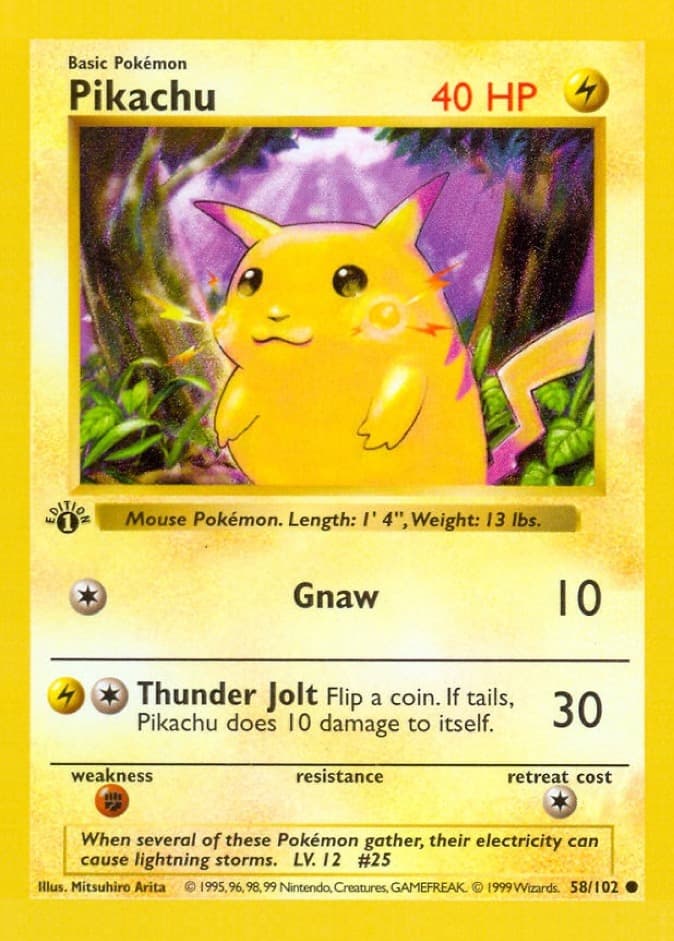
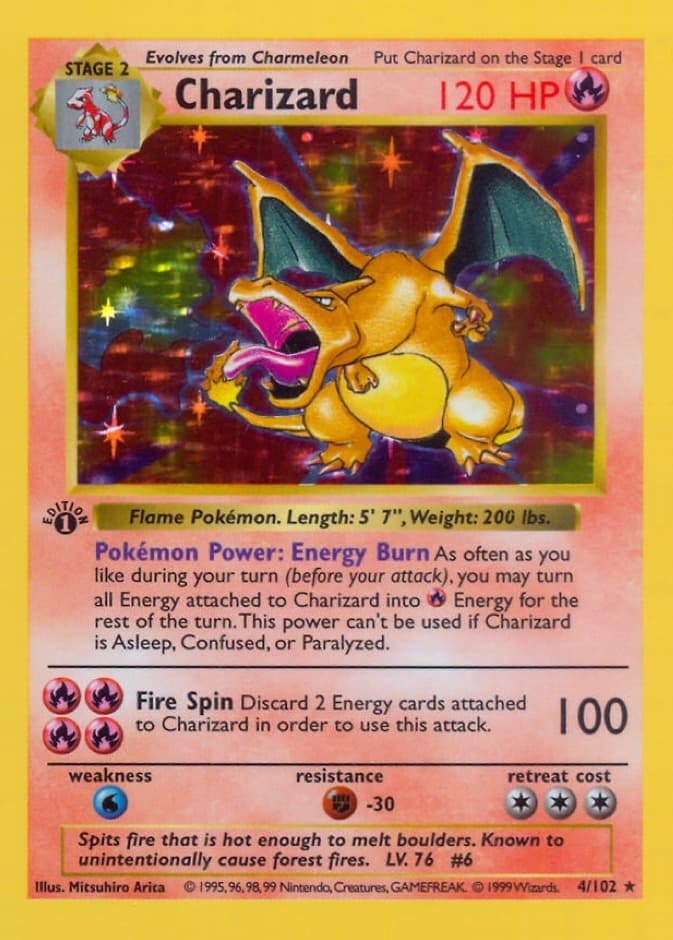
A 1st Edition Pokémon card is from the first print run of an English Wizards of the Coast set. It has a black circle with a “1” and the word EDITION, just below the art box’s lower left corner. Ten sets have them, Base Set (1999) to Neo Destiny (2002). Shadowless is Base Set’s second run: no stamp, no shadow.
Three words on an old card decide whether it’s worth a few hundred dollars or tens of thousands: 1st Edition, shadowless and unlimited. Each is a different print run of the same card, and the differences are small enough that sellers get them wrong all the time. Values below are from TCG Charts and PSA CardFacts on 21 October 2026.
What is a 1st Edition Pokémon card?
It’s a card from the first print run of a set, marked with the 1st Edition stamp. Wizards of the Coast printed English Pokémon cards from 1999 to 2003, stamped the first run of each early set, and then kept printing the same cards without the stamp. Those later copies are called unlimited.
The stamp matters because it marks the smaller run. PSA’s collecting guide puts it plainly: 1st Editions are typically more desirable and more valuable than their unlimited counterparts. How much more depends on the card, the set and, above all, the condition.
What Pokémon cards are 1st Edition?
Only cards from ten English sets, from Base Set in 1999 to Neo Destiny in 2002. CGC notes that no English card has carried the stamp since Neo Destiny, and Base Set 2 never had one.
- Base SetAlso shadowlessYes1999
- JungleYes1999
- FossilYes1999
- Team RocketYes2000
- Gym HeroesYes2000
- Gym ChallengeYes2000
- Neo GenesisYes2000
- Neo DiscoveryYes2001
- Neo RevelationYes2001
- Neo DestinyYes, the last2002
- Base Set 2No2000
- Legendary Collection, Expedition and laterNo2002 on
| Set | Released | 1st Edition print |
|---|---|---|
| Base SetAlso shadowless | 1999 | Yes |
| Jungle | 1999 | Yes |
| Fossil | 1999 | Yes |
| Team Rocket | 2000 | Yes |
| Gym Heroes | 2000 | Yes |
| Gym Challenge | 2000 | Yes |
| Neo Genesis | 2000 | Yes |
| Neo Discovery | 2001 | Yes |
| Neo Revelation | 2001 | Yes |
| Neo Destiny | 2002 | Yes, the last |
| Base Set 2 | 2000 | No |
| Legendary Collection, Expedition and later | 2002 on | No |
Wizards’ European printings had 1st Edition runs too, in German, French, Italian and Spanish among others, each with its own stamp. Japanese cards work differently, and they’re covered further down.
How can you tell if a Pokémon card is 1st Edition?
Look just below the lower left corner of the art box for a solid black circle with a “1” in it and EDITION in capitals arching over the top. No stamp means it isn’t 1st Edition, whatever the listing says. Then check the card around the stamp, because a stamp on its own proves little.
- Find the stamp in the right place. On Base Set Pokémon it sits on the left edge just under the art box. CGC notes Trainers carry it at the bottom left and Energy cards at the top right.
- Rule out the reprints. Base Set 2, Legendary Collection, Evolutions, Celebrations and Trading Card Game Classic reuse Base Set art with a different set symbol or foil. None of them is stamped.
- On Base Set, check the art box’s right edge. PSA says 1st Edition Base Set cards have no drop shadow there and a thinner HP font. A stamp on a card with a thick shadow is a reason to look much harder.
- Read the copyright line at the bottom. If it says 1999-2000, it’s the 2000 UK print, which is unlimited.
- Look at the stamp at an angle under a bright light. A real one is part of the print: crisp edges, flat with the surface, the same sheen as the other black ink.
How do you spot a fake 1st Edition stamp?
Most fake 1st Editions are real unlimited cards with a stamp printed on later. CGC found exactly that in April 2025 on Italian Clefairy and Magneton cards that had been run through a laser printer. Its graders listed the tells:
- The ink doesn’t match the color or sheen of a genuine stamp.
- The stamp is slightly raised, because it was printed on top of the gloss layer.
- Fine overspray around the circle, a sign of laser printing, clearer under magnification.
- Small creases from the printer, easiest to see in the holofoil.
What does shadowless mean on a Pokémon card?
Shadowless is Base Set’s second print run: no 1st Edition stamp, and no drop shadow along the right side of the art box. It exists only in the 1999 Base Set. Look at the yellow frame around the picture. On an unlimited card a dark shadow runs down its right edge; on shadowless and 1st Edition cards it doesn’t.
PSA describes the order this way. After the 1st Edition run, Wizards removed the stamp but kept the missing shadow and thin HP font, and those are the shadowless cards. Later it added the shadow and thickened the HP font, and those are unlimited. 1st Edition Base Set cards are shadowless too, which is why Sports Illustrated reported the $1,000,952.84 Charizard as a “1st Edition Shadowless.” A listing that says only “shadowless” is the second run.
What’s the difference between 1st Edition, shadowless and unlimited?
The stamp separates 1st Edition from the other two, and the art-box shadow separates shadowless from unlimited. Everything else follows from those two marks.
- Print run1st Edition FirstShadowless SecondUnlimited Third onward
- 1st Edition stamp1st Edition YesShadowless NoUnlimited No
- Shadow right of the art box1st Edition NoneShadowless NoneUnlimited Dark shadow
- HP font1st Edition ThinShadowless ThinUnlimited Thicker
- Copyright line1st Edition 1999Shadowless 1999Unlimited 1999, or 1999-2000 on the UK print
- Found in1st Edition Ten setsShadowless Base Set onlyUnlimited Every set
- Value1st Edition HighestShadowless MiddleUnlimited Lowest
| 1st Edition | Shadowless | Unlimited | |
|---|---|---|---|
| Print run | First | Second | Third onward |
| 1st Edition stamp | Yes | No | No |
| Shadow right of the art box | None | None | Dark shadow |
| HP font | Thin | Thin | Thicker |
| Copyright line | 1999 | 1999 | 1999, or 1999-2000 on the UK print |
| Found in | Ten sets | Base Set only | Every set |
| Value | Highest | Middle | Lowest |
How much are 1st Edition Pokémon cards worth?
A 1st Edition Base Set holo in PSA 9 sells for about 10 to 16 times the unlimited copy, and a shadowless one sits in between. Later 1st Editions carry a smaller premium: Neo-era holos sell for three to five times their unlimited versions.
- Charizard 4/102, Base SetTop cardShadowless $14,026 · Unlimited $3,720$60,250
- Shining Charizard 107/105, Neo DestinyUnlimited $6,078$22,477
- Lugia 9/111, Neo GenesisUnlimited $4,000$19,500
- Blastoise 2/102, Base SetShadowless $4,100 · Unlimited $1,150$11,850
- Venusaur 15/102, Base SetShadowless $1,900 · Unlimited $666$9,900
| Card | 1st Edition | Shadowless | Unlimited |
|---|---|---|---|
| Charizard 4/102, Base SetTop card | $60,250 | $14,026 | $3,720 |
| Shining Charizard 107/105, Neo Destiny | $22,477 | – | $6,078 |
| Lugia 9/111, Neo Genesis | $19,500 | – | $4,000 |
| Blastoise 2/102, Base Set | $11,850 | $4,100 | $1,150 |
| Venusaur 15/102, Base Set | $9,900 | $1,900 | $666 |
The top grade is a different market. A PSA 10 1st Edition Charizard sold for $550,000 at Heritage in December 2025, $954,800 at Goldin in February 2026, and $1,000,952.84 on eBay on September 9, 2026. TCG Charts values a shadowless PSA 10 at about $57,600 and an unlimited one at about $36,700. More on every version in our Charizard card value guide.
Raw cards sell for a fraction of these, and condition swings them more than anything else. Price your card against sold listings for the same printing and a similar condition, never against a different print. The method is in how much is my Pokémon card worth.
Are there 1st Edition cards in newer sets or in Japanese?
Not in English: no English card has been stamped since Neo Destiny in 2002. Japanese cards had their own 1st Edition mark for much longer, from the VS set in 2001 to the 20th Anniversary set in 2016.
The Japanese mark looks different, according to CGC: a large “1” above the word EDITION, between two horizontal lines, in the lower right corner of Pokémon and Trainer cards. CGC adds that Japanese 1st Editions are often far more common than their unlimited versions, so the mark adds much less value than it does on an English card.
Japanese Base Set, from 1996, has no 1st Edition mark at all. Its first print run left the rarity symbol off the cards, and collectors call those “No Rarity” copies; they play the role a 1st Edition stamp plays in English. Our guide to Japanese Pokémon cards covers the sets and symbols.
Should you grade a 1st Edition or shadowless card?
Usually yes for a Base Set holo in good shape. A slab confirms the printing and the authenticity, which buyers pay for, and the grade moves the price more than on any modern card. PSA records the printing as part of the card’s name, for example “Charizard-Holo 1st Edition” or “Charizard-Holo Shadowless.”
- Tens are rare. PSA has given 123 PSA 10s to the 1st Edition Charizard out of about 5,700 graded, near 2%, and 58 to the shadowless out of about 14,900, around 0.4%. The PSA population report guide shows how to read those counts.
- The grade is most of the price. The same 1st Edition Charizard is about $60,000 in PSA 9 and has sold for $550,000 to $1 million in PSA 10. The PSA grading scale explains what separates them.
- A slab settles the stamp question. For a big purchase, buy graded and check the certificate number with a PSA cert lookup.
- Cheap 1st Editions often don’t pay. A 1st Edition common worth $20 raw doesn’t cover a $59.99 fee unless its PSA 10 sells for far more. Run the numbers first with is it worth grading Pokémon cards.
Questions people ask
Are all shadowless Pokémon cards 1st Edition?
No. 1st Edition Base Set cards are shadowless, but the second Base Set print run is also shadowless and has no stamp. Those are the cards collectors simply call shadowless, and they sell for less than 1st Edition.
What does a 1st Edition stamp look like?
On English cards it’s a solid black circle with a “1” in the middle and the word EDITION in capitals curving over the top. It sits just below the lower left corner of the art box on Pokémon cards.
Does Base Set 2 have 1st Edition cards?
No. Base Set 2 from 2000 reprinted earlier cards and never had a 1st Edition run. Legendary Collection and the e-Card sets that followed weren’t stamped either.
Are new Pokémon cards 1st Edition?
Not in English, where the last stamped set was Neo Destiny in 2002. Japanese sets carried a 1st Edition mark from 2001 until the 20th Anniversary set in 2016, and those first prints are often more common than the later ones.
How much is a 1st Edition Charizard worth?
On 21 October 2026 TCG Charts valued a PSA 9 at about $60,250. PSA 10 copies have sold for $550,000 to $1,000,952.84 since December 2025, while raw copies depend heavily on condition.
Sources
- PSA, Pokémon Collecting Basics Guide: 1st Edition, Shadowless, Unlimited, reprints (checked 21 October 2026)
- CGC, How to Tell if a Pokémon Card is a First Edition, June 3, 2022 (checked 21 October 2026)
- CGC, Altered Card Alert: 1st Edition Italian Pokémon Cards, April 8, 2025 (checked 21 October 2026)
- CGC, Pokémon: A Guide to the Rarest and Most Expensive Charizard Cards (No Rarity print) (checked 21 October 2026)
- PSA CardFacts, 1999 Pokémon Game Charizard-Holo 1st Edition: population and label (checked 21 October 2026)
- PSA CardFacts, 1999 Pokémon Game Charizard-Holo Shadowless: population, label and last PSA 10 sale (checked 21 October 2026)
- PSA, Trading card grading service levels and prices (checked 21 October 2026)
- Sports Illustrated, Another $1 million Charizard leads biggest TCG sales, September 14, 2026 (checked 21 October 2026)
- Heritage Auctions / Intelligent Collector, PSA 10 Charizard record $550,000, December 2025 (checked 21 October 2026)
- Dexerto, Gold Star Rayquaza becomes first English Pokémon card to sell for $1 million (the $954,800 Goldin Charizard) (checked 21 October 2026)
- TCG Charts, Charizard #4 1st Edition graded values (checked 21 October 2026)
- TCG Charts, Charizard #4 Shadowless graded values (checked 21 October 2026)
- TCG Charts, Charizard #4 unlimited graded values and population (checked 21 October 2026)
- TCG Charts, Blastoise #2 1st Edition, Shadowless and unlimited graded values (checked 21 October 2026)
- TCG Charts, Venusaur #15 1st Edition, Shadowless and unlimited graded values (checked 21 October 2026)
- TCG Charts, Lugia #9 Neo Genesis 1st Edition and unlimited graded values (checked 21 October 2026)
- TCG Charts, Shining Charizard #107 Neo Destiny 1st Edition and unlimited graded values (checked 21 October 2026)
Buddy is independent and isn’t affiliated with PSA, CGC, Beckett, TAG, SGC or The Pokémon Company. Fees and prices change; we re-check them when we update a guide.